
SpeciesBearded pygmy chameleon
Bearded pygmy chameleon
Rieppeleon brevicaudatus
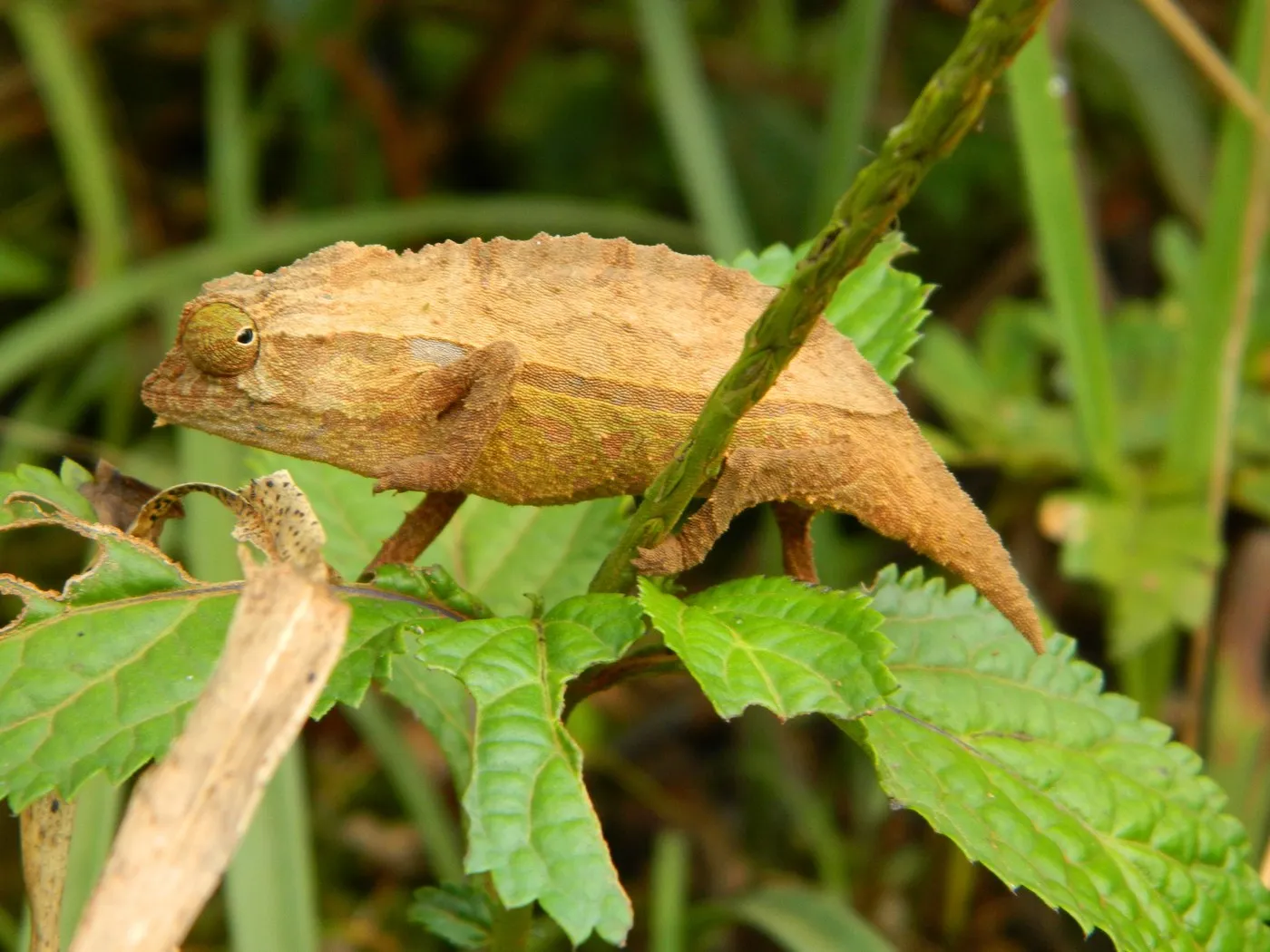
A pygmy chameleon from the leaf litter of East African forests: About 8 cm long, brown like a withered leaf and, unlike most chameleons, suited to small groups. Like all chameleons, it requires a permit.
- Group
- Chameleon
- Level
- Intermediate
- Origin
- East Africa
Where the species comes from
- World region
- East Africa
- Countries
- Eastern Tanzania, including the Usambara and Uluguru Mountains, and Kenya
- Habitat
- Leaf litter, grass and low vegetation of evergreen forests, from sea level up to about 1300 m
The app does not yet hold an origin entry for this species. The distribution given here comes from the specialist literature.
The natural habitat is the yardstick for how you furnish an enclosure. Knowing where an animal comes from is knowing why it needs heat zones, hides and a particular humidity.
Husbandry at a glance
The same details appear in the animal’s profile inside the app.
- Enclosure
- Floor area before height: These animals live close to the ground and hardly climb high. Well ventilated, with dense, low planting.
- Temperature
- 15–25 °C during the day, up to 25 °C at the basking spot, not below 15 °C at night. Above 26 °C it becomes life-threatening: In summer, heat is the main problem.
- Humidity
- 70–90 %, mist generously several times a day or use a fogger.
- Lighting
- UVB lamp and heat lamp above an open spot, separated from the animal by a mesh.
- Substrate
- 5–7 cm of coco fibre or potting soil with leaves, no sand: It gets swallowed along with prey. Keep some spots moist; that is where females lay their eggs.
- Furnishings
- Low, dense plants, moss, thin twigs and dry leaves as cover, plus a small open spot under the lamp.
- Water
- Drinks droplets from leaves and moss: Misting or a drip system; a bowl is useless.
- Feeding
- Very small insects such as fruit flies, houseflies and small crickets, no bigger than the width of the head. Adults four to six every other day; calcium twice a week, vitamins once a month.
- Behaviour
- Diurnal and close to the ground in the leaf litter. At night it sleeps in the open on low twigs and then looks like a withered leaf.
- Handling
- Handle as little as possible: An animal for watching.
- Cohabitation
- Unlike most chameleons, it tolerates company: Singly, as a pair or in a small group of up to four with only one male. Never several males together.
- Health
- Wild-caught animals are often in poor condition and then frequently do not live long: Prefer captive-bred animals. Keeping them too dry damages the kidneys, and females can become egg-bound. Kept well, up to about six years.
- Seasonal cycle
- No winter rest. In summer, guard against heat: Never place the terrarium in the sun or next to a radiator, and monitor the temperature with a thermometer.
- Safety
- All chameleons require a permit under Art. 89 of the Ordinance: Obtain it before buying.
Legal position in Switzerland
Permit required
Requires a permit. Art. 89 let. f of the Ordinance expressly names “all chameleons (Chamaeleonidae)”: Without exception and regardless of size. The cantonal veterinary office issues the permit before acquisition. For all chameleons except the veiled chameleon, it requires an expert report by an independent, recognised specialist confirming that the planned enclosures and facilities allow animal-appropriate keeping (Art. 92 para. 1 let. h of the Ordinance); the applicant and the authority choose the specialist together
Training required
Proof of competence under Art. 85 para. 3 let. c of the Ordinance is required. It is a precondition for the permit and must be obtained before acquisition
Species protection applies
CITES Appendix II: Import and transfer only with papers. When buying, ask for proof of origin and captive breeding
Minimum enclosure dimensions
Annex 2, table 5 of the Animal Welfare Ordinance does not prescribe centimetres but multiples of body length. For this species, item 15 (Ground chameleons): floor area 6 × 4 body lengths, height 4 body lengths. The floor area applies to one animal; each further animal requires an additional 2 × 2 body lengths.
For this group, body length means the snout-vent length, without the tail. The largest animal in the enclosure is what counts. The enclosure may not be smaller even if fewer animals live in it than the table names.
| Snout-vent length | At least |
|---|---|
| 4 cm | 24 × 16 × 16 cm |
| 5 cm | 30 × 20 × 20 cm |
| 6 cm | 36 × 24 × 24 cm |
Animals may temporarily be kept in smaller enclosures: for quarantine, for the treatment of illness and injury, for acclimatisation, for breeding and rearing, and for winter or cold dormancy or aestivation (preliminary remark D on reptiles).
This is the legal lower limit, not a recommendation. An enclosure that meets exactly these dimensions is permitted, but not good for that reason. The details under “Husbandry at a glance” describe how the enclosure should be furnished, not how small it may be.
What the enclosure must provide
A permit must be applied for at the cantonal veterinary office before keeping the animal. For ground chameleons, Annex 2, Table 5 of the Ordinance (item 15) requires a well-ventilated enclosure with at least two walls of wire mesh, as well as a temperature suited to the animals’ needs with a heat source and places to hide. The social structure must be respected. High humidity therefore has to be maintained despite the mesh walls, for instance with dense planting and frequent misting.
Paperwork
Keep the keeping permit, certificate of competence, purchase contract and an unbroken proof of origin. For CITES-protected species, the required CITES documents and species protection checks apply to every border crossing.
These details are a guide, not legal advice. Binding information comes from the cantonal veterinary office; the text of the ordinance is what counts. More on the legal position

