
SpeciesCrested gecko
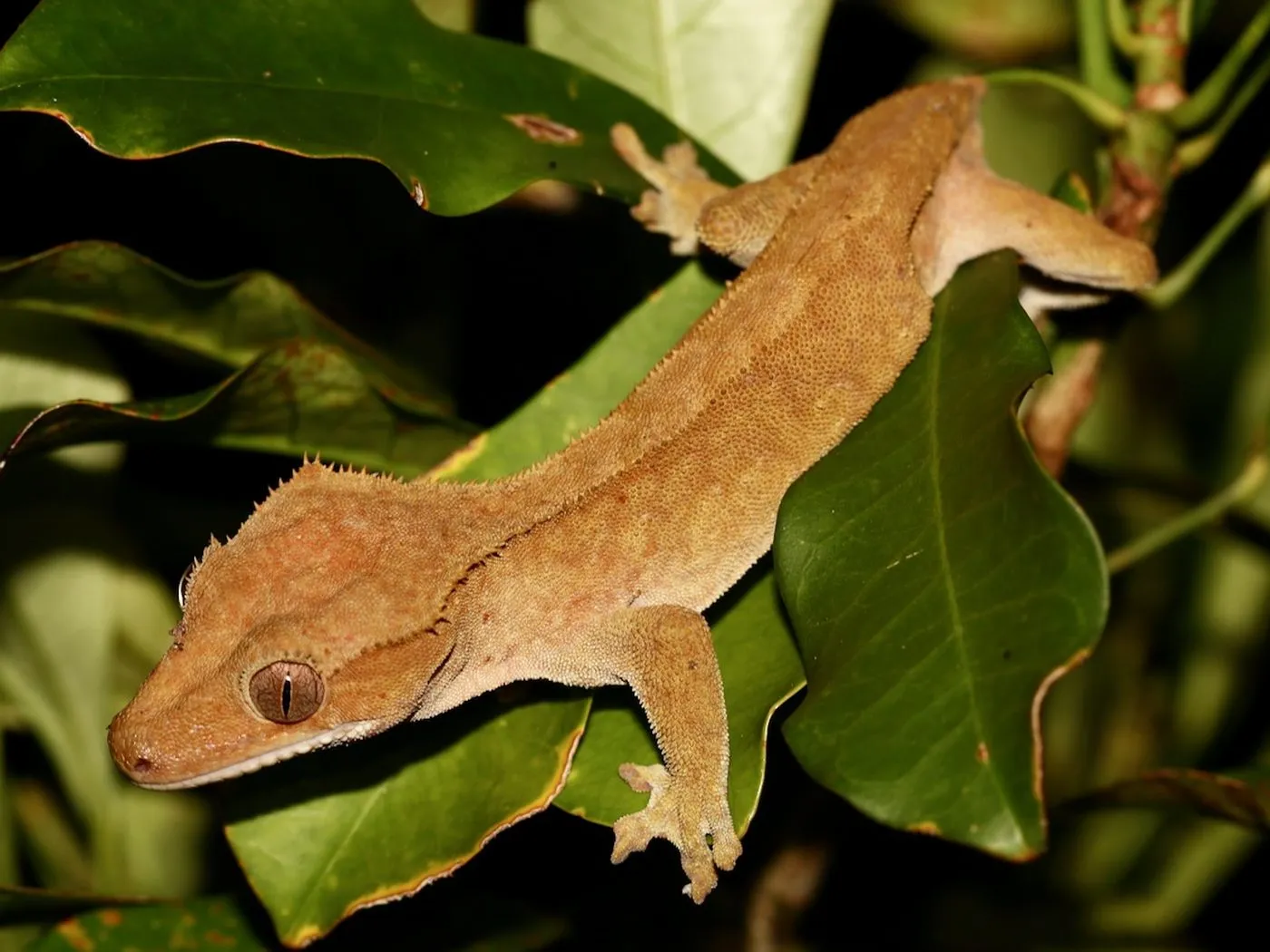
Crested gecko
Correlophus ciliatus
A nocturnal climber from New Caledonia that gets by without strong heat. Height, humidity and climbing structure are what matter here.
- Group
- Gecko
- Level
- Beginner
- Origin
- New Caledonia
Where the species comes from
- World region
- New Caledonia
- Countries
- Southern New Caledonia and its offshore islands
- Habitat
- Humid tropical forest and densely vegetated forest edges
The natural habitat is the yardstick for how you furnish an enclosure. Knowing where an animal comes from is knowing why it needs heat zones, hides and a particular humidity.
Husbandry at a glance
The same details appear in the animal’s profile inside the app.
- Enclosure
- Upright format, height before floor area. The Animal Welfare Ordinance sets no minimum size for crested geckos. The reference is the German 1997 expert report on reptile keeping: for a pair at least 6 × 6 × 8 snout-vent lengths, i.e. 66 × 66 × 88 cm at 11 cm. Swiss Animal Protection (STS) recommends 80 × 60 × 120 cm for one or two animals. Meeting both means roughly 80 × 66 × 120 cm.
- Temperature
- 22–26 °C by day, 18–20 °C at night. Above 28 °C it gets dangerous.
- Humidity
- 60–80 %, mist in the evening, let it dry during the day.
- Lighting
- Weak UV-B is beneficial, but not essential.
- Substrate
- Coco humus with leaf litter.
- Furnishings
- Cork tubes, many branches, broad-leaved plants for sleeping.
- Water
- Droplets on leaves and a small dish.
- Feeding
- Ready-made fruit gecko diet two to three times a week, plus insects once a week.
- Behaviour
- Nocturnal, jumps well, spends the day under leaves.
- Handling
- Brief and rare. The tail is dropped and does not grow back: Permanently in this species.
- Cohabitation
- Alone or as a pair. Never two males together.
- Health
- Very robust. Heat above 30 °C and permanently wet keeping are the main risks.
- Seasonal cycle
- A slight drop in winter to 20 °C.
- Safety
- No permit required.
Legal position in Switzerland
No permit foreseen
No permit required. The species does not belong to any of the groups listed in Art. 89 of the Swiss Animal Welfare Ordinance
No certificate of competence foreseen
No proof of competence required. It is only demanded for the animals named in Art. 89 of the Ordinance
No CITES listing
Not listed in the CITES appendices: Import and transfer require no species-protection papers. Keep the proof of purchase nonetheless
Minimum enclosure dimensions
Annex 2, table 5 of the Animal Welfare Ordinance does not list this species. Among snakes the table names only giant snakes (pythons and boas), elapids, vipers and pit vipers, and a few venomous or dangerous colubrids; for the rest no figure appears there.
The general rule in Annex 2 (letter K) then applies: the enclosure must be large enough for everything the species needs (hides, basking spot, climbing branches) to be arranged sensibly. As a yardstick, the ordinance points to expert opinions on a scientific basis. There is therefore no binding figure. The guide values in the calculator come from the 1997 expert report. Binding information comes from the cantonal veterinary office.
What the enclosure must provide
Ensure species-appropriate heat and light zones, UV-B where applicable, suitable substrate, places to retreat, opportunities to climb or dig, water, humidity and natural rest periods. The social structure of the species must be taken into account.
Paperwork
Keep the purchase contract and proof of origin. Use the scientific name to check CITES and import status reliably.
These details are a guide, not legal advice. Binding information comes from the cantonal veterinary office; the text of the ordinance is what counts. More on the legal position

