
SpeciesBall python
Ball python
Python regius
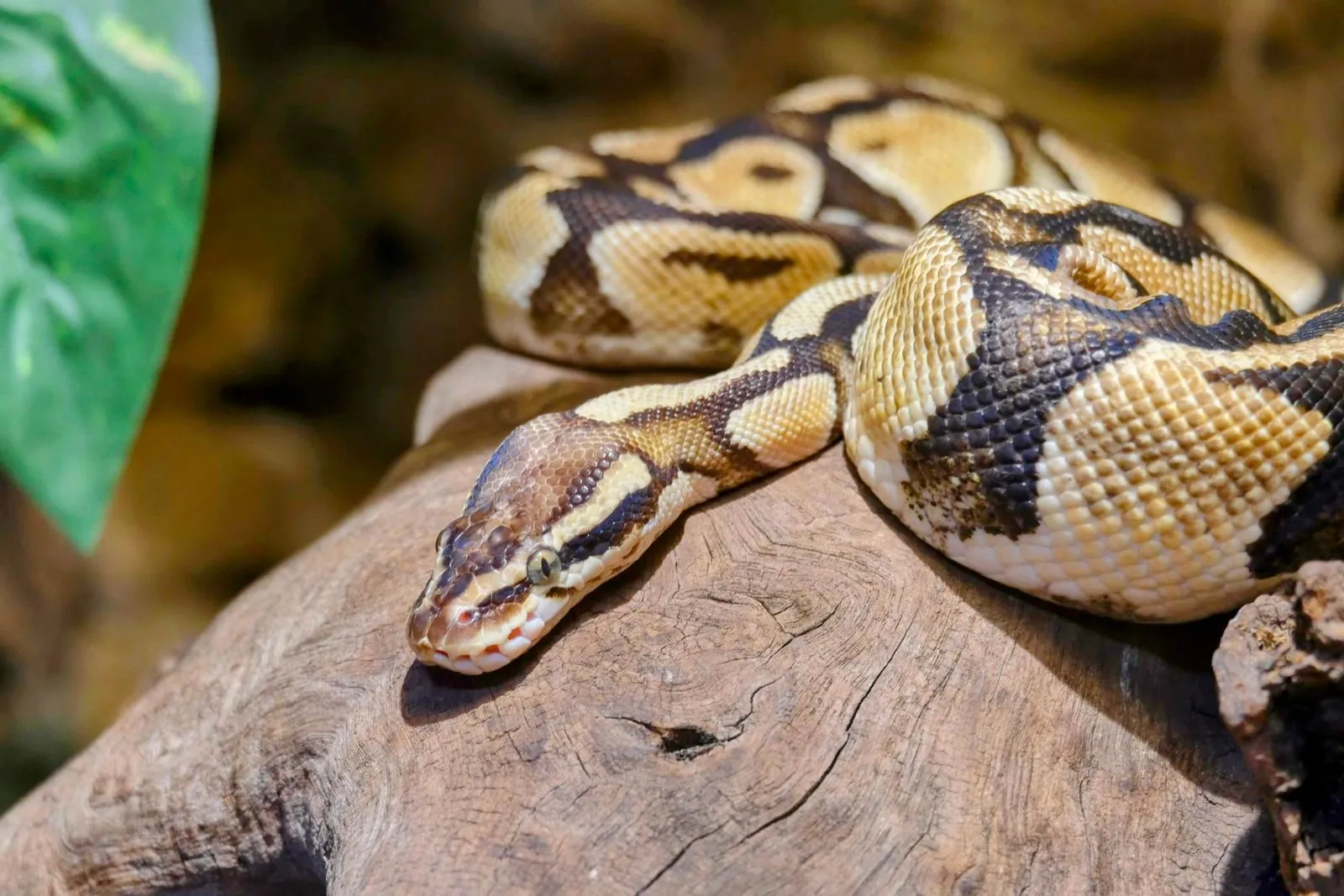
Calm, compact and available in countless colour morphs. The ball python is unforgiving about climate and hiding places. Refusing food is normal for it, but never something to leave unwatched.
- Group
- Snake
- Level
- Beginner
- Origin
- West and Central Africa
Where the species comes from
- World region
- West and Central Africa
- Countries
- From Senegal and Ghana to Cameroon, Chad and Uganda
- Habitat
- Savannah, grassland, open woodland and farmland
The natural habitat is the yardstick for how you furnish an enclosure. Knowing where an animal comes from is knowing why it needs heat zones, hides and a particular humidity.
Husbandry at a glance
The same details appear in the animal’s profile inside the app.
- Enclosure
- A well-structured enclosure with usable floor space. Tight hides matter more than open floor.
- Temperature
- Warm hide zone around 30–32 °C, heated surface roughly 32–35 °C, cool zone 22–27 °C. Always control heat with a thermostat.
- Humidity
- Usually around 60–80 %, temporarily higher at night and during a shed. Maintain good ventilation and dry resting areas.
- Lighting
- A day–night cycle, bright full-spectrum light and suitable low-level UVB are recommended.
- Substrate
- Moisture-retaining but not wet; for example suitable soil, a coir and bark mix or a bioactive substrate.
- Furnishings
- At least two snug hides, visual barriers, cork, low sturdy climbing branches and structured routes.
- Water
- A large, stable water bowl, cleaned and refilled regularly.
- Feeding
- Appropriately sized thawed rodents. Do not feed adults on a rigid, overly short schedule; let body condition and weight guide you.
- Behaviour
- Crepuscular and nocturnal, rather retiring. Longer breaks from feeding can occur seasonally but must be assessed together with weight and health.
- Handling
- Briefly and calmly; disturb as little as possible while the animal settles in, during a shed and after feeding.
- Cohabitation
- Keep singly.
- Health
- Watch especially for dehydration, respiratory diseases, mites, mouth rot and obesity. Morphs bred for colour and pattern can carry hereditary defects: In the Spider morph and its combinations, the so-called wobble occurs, a neurological defect with head tremors and loss of orientation. It is inseparably linked to the trait and cannot be bred out. Anyone buying an animal should ask about the morph and observe it calmly before buying.
- Seasonal cycle
- The ball python does not hold a winter rest like a European species: It comes from the savannas of West Africa, where there is no winter but a cooler dry season from about November to February. During this time it is less active and often eats nothing for weeks or months. This is normal and no cause for concern as long as the weight stays stable: Weigh it weekly, and only see the vet if it loses more than ten percent or shows additional signs. For breeding, the dry season is deliberately recreated with a night-time drop to about 22–24 °C over six to eight weeks. This is not necessary for a pet.
- Safety
- A powerful constrictor; never let children handle it unsupervised.
Legal position in Switzerland
No permit foreseen
No permit required. The species does not belong to any of the groups listed in Art. 89 of the Swiss Animal Welfare Ordinance
No certificate of competence foreseen
No proof of competence required. It is only demanded for the animals named in Art. 89 of the Ordinance
Species protection applies
CITES Appendix II: Import and transfer only with papers. When buying, ask for proof of origin and captive breeding
Minimum enclosure dimensions
Annex 2, table 5 of the Animal Welfare Ordinance does not prescribe centimetres but multiples of body length. For this species, item 43a (Small and medium pythons and boas): floor area 1 × 0.5 body lengths, height 0.75 body lengths. The floor area applies to at most two animals; each further animal requires an additional 0.5 × 0.2 body lengths.
For this group, body length means the total length, from snout to tail tip. The largest animal in the enclosure is what counts. The enclosure may not be smaller even if fewer animals live in it than the table names.
| Total length | At least |
|---|---|
| 90 cm | 90 × 45 × 68 cm |
| 110 cm | 110 × 55 × 83 cm |
| 130 cm | 130 × 65 × 98 cm |
| 150 cm | 150 × 75 × 113 cm |
| 180 cm | 180 × 90 × 135 cm |
Animals may temporarily be kept in smaller enclosures: for quarantine, for the treatment of illness and injury, for acclimatisation, for breeding and rearing, and for winter or cold dormancy or aestivation (preliminary remark D on reptiles).
This is the legal lower limit, not a recommendation. An enclosure that meets exactly these dimensions is permitted, but not good for that reason. The details under “Husbandry at a glance” describe how the enclosure should be furnished, not how small it may be.
What the enclosure must provide
The enclosure must be escape-proof and provide species-appropriate temperature zones, humidity, hides, water and, where applicable, raised resting areas. Unusually large, dangerous or commercial set-ups may be subject to further rules.
Paperwork
Keep an unbroken proof of origin and the purchase contract. Clarify CITES permits and species protection checks in advance of any border crossing.
These details are a guide, not legal advice. Binding information comes from the cantonal veterinary office; the text of the ordinance is what counts. More on the legal position
