
SpeciesGreen iguana
Green iguana
Iguana iguana
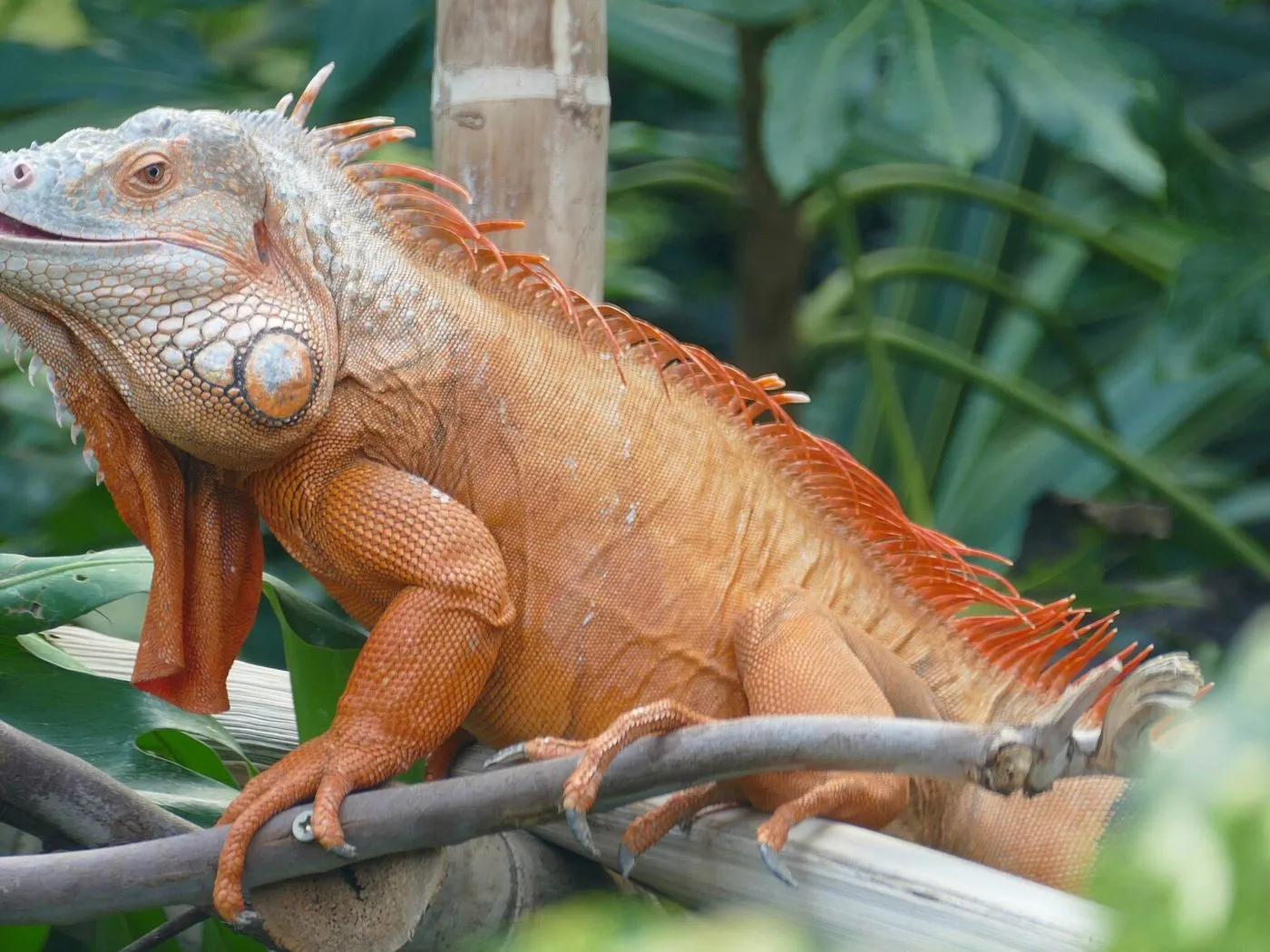
It grows very large and lives in trees. The space an adult needs exceeds any off-the-shelf enclosure. Requires a permit in Switzerland.
- Group
- Lizard
- Level
- Advanced
- Origin
- Central and South America
Where the species comes from
- World region
- Central and South America
- Countries
- From southern Mexico through Central America to Brazil and Paraguay
- Habitat
- Tropical forest, riverbanks, mangroves and humid scrubland
The natural habitat is the yardstick for how you furnish an enclosure. Knowing where an animal comes from is knowing why it needs heat zones, hides and a particular humidity.
Husbandry at a glance
The same details appear in the animal’s profile inside the app.
- Enclosure
- Effectively a room of its own. If you cannot provide that space, do not keep the species.
- Temperature
- Basking spot at 38–40 °C, ambient 28–32 °C, 22–24 °C at night.
- Humidity
- 70–80 %, mist several times a day or use a rain system.
- Lighting
- Very strong UV-B for twelve hours. The need is particularly high in this species.
- Substrate
- Soil-bark mix, easy to clean.
- Furnishings
- Sturdy sloping branches up to the ceiling, broad resting surfaces, visual cover.
- Water
- Large bathing basin, refreshed daily.
- Feeding
- Plants only: leaves, herbs, vegetables. No animal protein: It causes kidney damage.
- Behaviour
- Diurnal, climbs, basks at length. Males become aggressive in the breeding season, towards people too.
- Handling
- Adult males can injure seriously: Tail lashes, claws, bite. Caution is not overstated.
- Cohabitation
- Alone. Never two males.
- Health
- Bone loss from a lack of UV-B and kidney damage from the wrong food are the most common causes of death.
- Seasonal cycle
- No winter rest: The green iguana comes from tropical Central and South America. A drier phase of six to eight weeks with a night-time drop to 20–22 °C matches the yearly rhythm. Daytime values and UV supply remain unchanged — for this species neither is negotiable, even in winter.
- Safety
- Iguanas over one metre in total length require a permit under Art. 89 of the Ordinance and proof of competence. The green iguana grows considerably longer: Obtain the permit before buying.
Legal position in Switzerland
Permit required
Requires a permit. Art. 89 let. f of the Ordinance covers iguanas that reach more than 1 m total length as adults: The green iguana grows considerably longer. Obtain the permit before acquisition
Training required
Proof of competence under Art. 85 para. 3 let. c of the Ordinance is required. It is a precondition for the permit and must be obtained before acquisition
Species protection applies
CITES Appendix II: Import and transfer only with papers. When buying, ask for proof of origin and captive breeding
Minimum enclosure dimensions
Annex 2, table 5 of the Animal Welfare Ordinance does not prescribe centimetres but multiples of body length. For this species, item 16 (Green iguanas): floor area 4 × 3 body lengths, height 4 body lengths. The floor area applies to at most two animals; each further animal requires an additional 2 × 2 body lengths.
For this group, body length means the snout-vent length, without the tail. The largest animal in the enclosure is what counts. The enclosure may not be smaller even if fewer animals live in it than the table names.
| Snout-vent length | At least |
|---|---|
| 30 cm | 120 × 90 × 120 cm |
| 40 cm | 160 × 120 × 160 cm |
| 50 cm | 200 × 150 × 200 cm |
Animals may temporarily be kept in smaller enclosures: for quarantine, for the treatment of illness and injury, for acclimatisation, for breeding and rearing, and for winter or cold dormancy or aestivation (preliminary remark D on reptiles).
This is the legal lower limit, not a recommendation. An enclosure that meets exactly these dimensions is permitted, but not good for that reason. The details under “Husbandry at a glance” describe how the enclosure should be furnished, not how small it may be.
What the enclosure must provide
The expected final size must be checked using the scientific name. Have the permit requirement and training confirmed by the veterinary office before acquiring the animal. Species-appropriate heat, UV, light, humidity, bathing, digging and climbing provision and a secure enclosure construction are required.
Paperwork
Always keep the proof of origin and purchase contract. For species subject to a permit or to CITES, also secure the keeping permit, certificate of competence and species protection papers.
These details are a guide, not legal advice. Binding information comes from the cantonal veterinary office; the text of the ordinance is what counts. More on the legal position

