
SpeciesTokay gecko
Tokay gecko
Gekko gecko
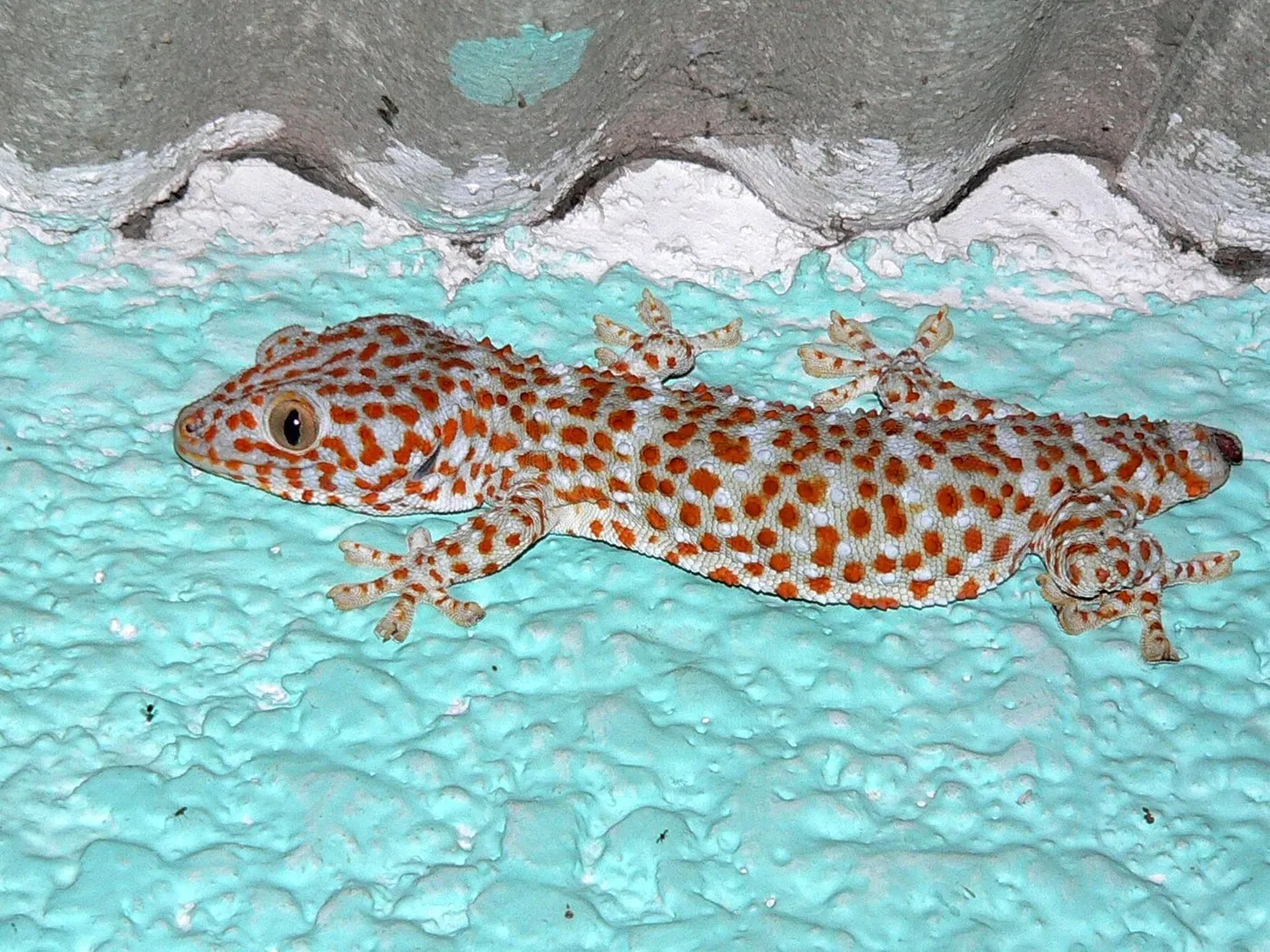
Large, colourful and loud: Its call gives it its name. It bites hard and does not let go quickly; a species to watch, not to handle.
- Group
- Gecko
- Level
- Intermediate
- Origin
- Southeast Asia
Where the species comes from
- World region
- Southeast Asia
- Countries
- From India to Indonesia and the Philippines
- Habitat
- Tree hollows, rocks and house walls in warm lowlands
The app does not yet hold an origin entry for this species. The distribution given here comes from the specialist literature.
The natural habitat is the yardstick for how you furnish an enclosure. Knowing where an animal comes from is knowing why it needs heat zones, hides and a particular humidity.
Husbandry at a glance
The same details appear in the animal’s profile inside the app.
- Enclosure
- Upright format with climbing walls. The Animal Welfare Ordinance sets no minimum size for tokay geckos. The reference is the German 1997 expert report on reptile keeping: for a pair at least 6 × 6 × 8 snout-vent lengths, i.e. 102 × 102 × 136 cm at 17 cm.
- Temperature
- 28–32 °C by day, 35 °C in places, 24 °C at night.
- Humidity
- 70–80 %, mist daily.
- Lighting
- Weak UV-B is beneficial, twelve hours.
- Substrate
- Coco humus with leaf litter.
- Furnishings
- Vertical cork tubes as a cave, sturdy branches, a climbable back wall.
- Water
- A dish and droplets on leaves.
- Feeding
- Sturdy insects twice a week, adults occasionally a small mouse.
- Behaviour
- Nocturnal, calls loudly, defends its hide with determination.
- Handling
- Do not handle. The bite is painful and the animal does not let go quickly.
- Cohabitation
- A pair given enough space. Never two males.
- Health
- Robust when the humidity is right.
- Seasonal cycle
- No winter rest: Tropical South-East Asia. A drier phase of six to eight weeks with a night-time drop to 22–24 °C matches the yearly rhythm and initiates the mating season. Not necessary without breeding plans.
- Safety
- No permit required. CITES-protected since 2019.
Legal position in Switzerland
No permit foreseen
No permit required. The species does not belong to any of the groups listed in Art. 89 of the Swiss Animal Welfare Ordinance
No certificate of competence foreseen
No proof of competence required. It is only demanded for the animals named in Art. 89 of the Ordinance
Species protection applies
CITES Appendix II: Import and transfer only with papers. When buying, ask for proof of origin and captive breeding
Minimum enclosure dimensions
Annex 2, table 5 of the Animal Welfare Ordinance does not list this species. Among snakes the table names only giant snakes (pythons and boas), elapids, vipers and pit vipers, and a few venomous or dangerous colubrids; for the rest no figure appears there.
The general rule in Annex 2 (letter K) then applies: the enclosure must be large enough for everything the species needs (hides, basking spot, climbing branches) to be arranged sensibly. As a yardstick, the ordinance points to expert opinions on a scientific basis. There is therefore no binding figure. The guide values in the calculator come from the 1997 expert report. Binding information comes from the cantonal veterinary office.
What the enclosure must provide
Provide species-appropriate heat and light zones, UV-B where needed, suitable substrate, retreats, climbing or digging options, water and natural rest periods.
Paperwork
Keep the purchase contract and proof of origin. Use the scientific name to check CITES and import status reliably.
These details are a guide, not legal advice. Binding information comes from the cantonal veterinary office; the text of the ordinance is what counts. More on the legal position

_(7109782823).jpg)