
SpeciesRed-eared slider
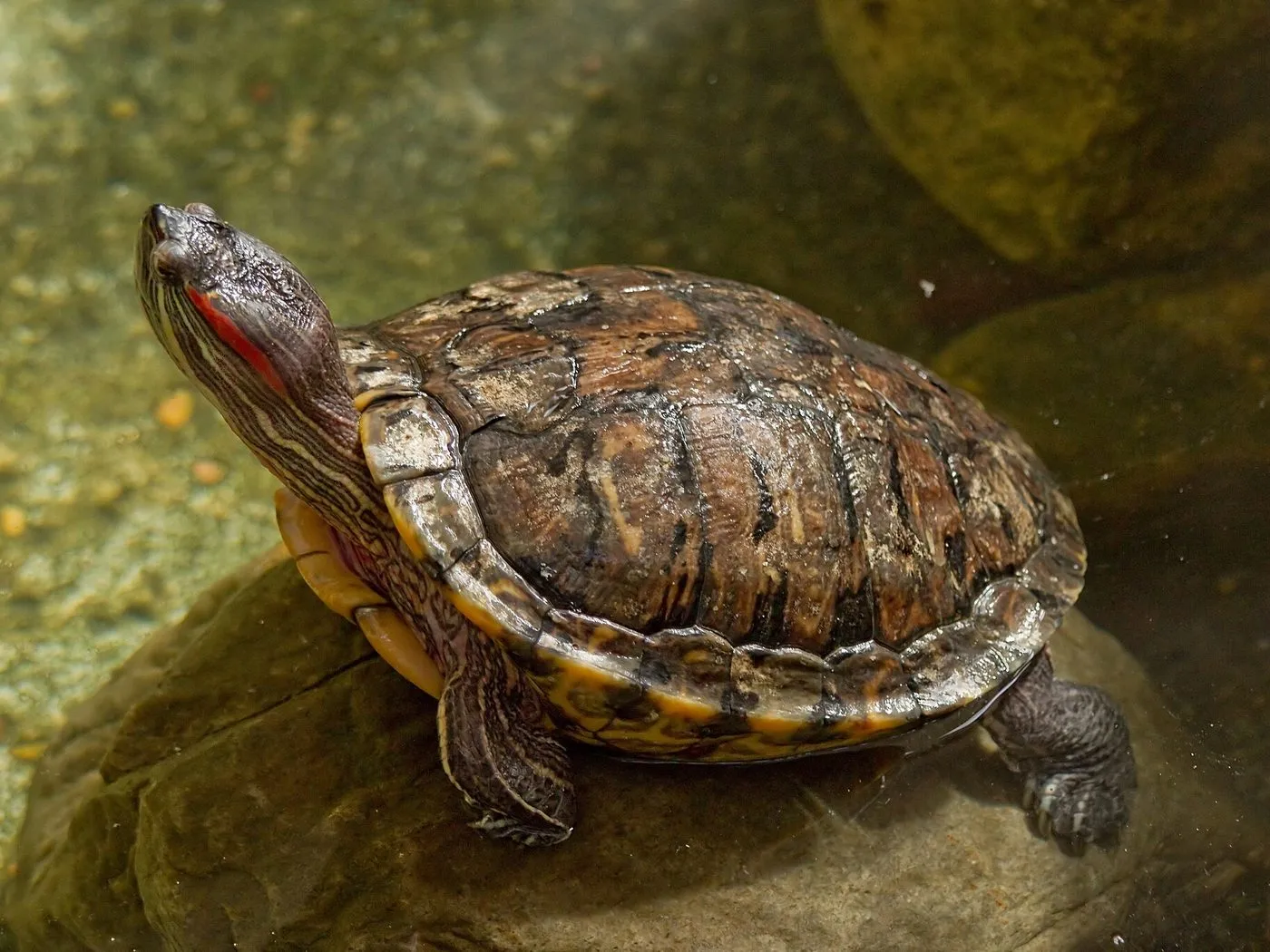
Red-eared slider
Trachemys scripta elegans
An aquatic turtle with high space and filtration demands that grows large and lives long. In Europe it counts as an invasive species. Releasing it is prohibited and punishable.
- Group
- Tortoise or turtle
- Level
- Intermediate
- Origin
- North America
Where the species comes from
- World region
- North America
- Countries
- Originally the southern United States and northern Mexico
- Habitat
- Calm, warm fresh water with dense bankside vegetation
The natural habitat is the yardstick for how you furnish an enclosure. Knowing where an animal comes from is knowing why it needs heat zones, hides and a particular humidity.
No husbandry guidance
This species is prohibited in Switzerland. ReptiCare therefore publishes no husbandry guidance for it: no dimensions, no climate, no furnishing, no feeding. Anyone who does not already keep one should not acquire one.
No garden pond and no outdoor keeping: article 15 of the Release Ordinance prohibits handling in the environment. Releasing the animal is a criminal offence and is the reason for the ban.
Anyone already keeping one should not pass it on and not release it, but clarify the next steps with the Federal Office for the Environment or the cantonal office. Rescue centres take animals in.
Legal position in Switzerland
Prohibited in Switzerland
It is not animal welfare law that governs here but the Release Ordinance: the species is listed in annex 2.1 as an invasive alien organism. Article 15 paragraph 2 prohibits any direct handling in the environment, so no garden pond, no outdoor keeping, no release. A ban on acquiring or keeping the animal does not appear in the ordinance text; the Federal Office for the Environment reads the provision more strictly and considers that impermissible too. Ask the Federal Office or your cantonal office before buying
No certificate of competence foreseen
No proof of competence required. It is only demanded for the animals named in Art. 89 of the Ordinance
No CITES listing
Not listed in the CITES appendices. What applies here is the Release Ordinance, not species protection — see above. Keep the proof of purchase nonetheless
We do not give minimum dimensions here: they describe what an enclosure for this species would have to look like, which is the wrong information for a prohibited species. Anyone already keeping one should discuss housing with the cantonal office.
What the enclosure must provide
The species eats the spawn of native amphibians, which is why it was listed. Garden ponds and outdoor keeping are prohibited, releasing the animal is a criminal offence. Anyone already keeping one should clarify the next steps with the Federal Office for the Environment or the cantonal office; rescue centres take animals in.
Paperwork
Keep the purchase receipt and proof of origin. The list of invasive alien organisms is in Annex 2 of the Release Ordinance (RO); the Federal Office for the Environment may grant a case-by-case exemption for handling in the environment.
These details are a guide, not legal advice. Binding information comes from the cantonal veterinary office; the text of the ordinance is what counts. More on the legal position

