
SpeciesReticulated python
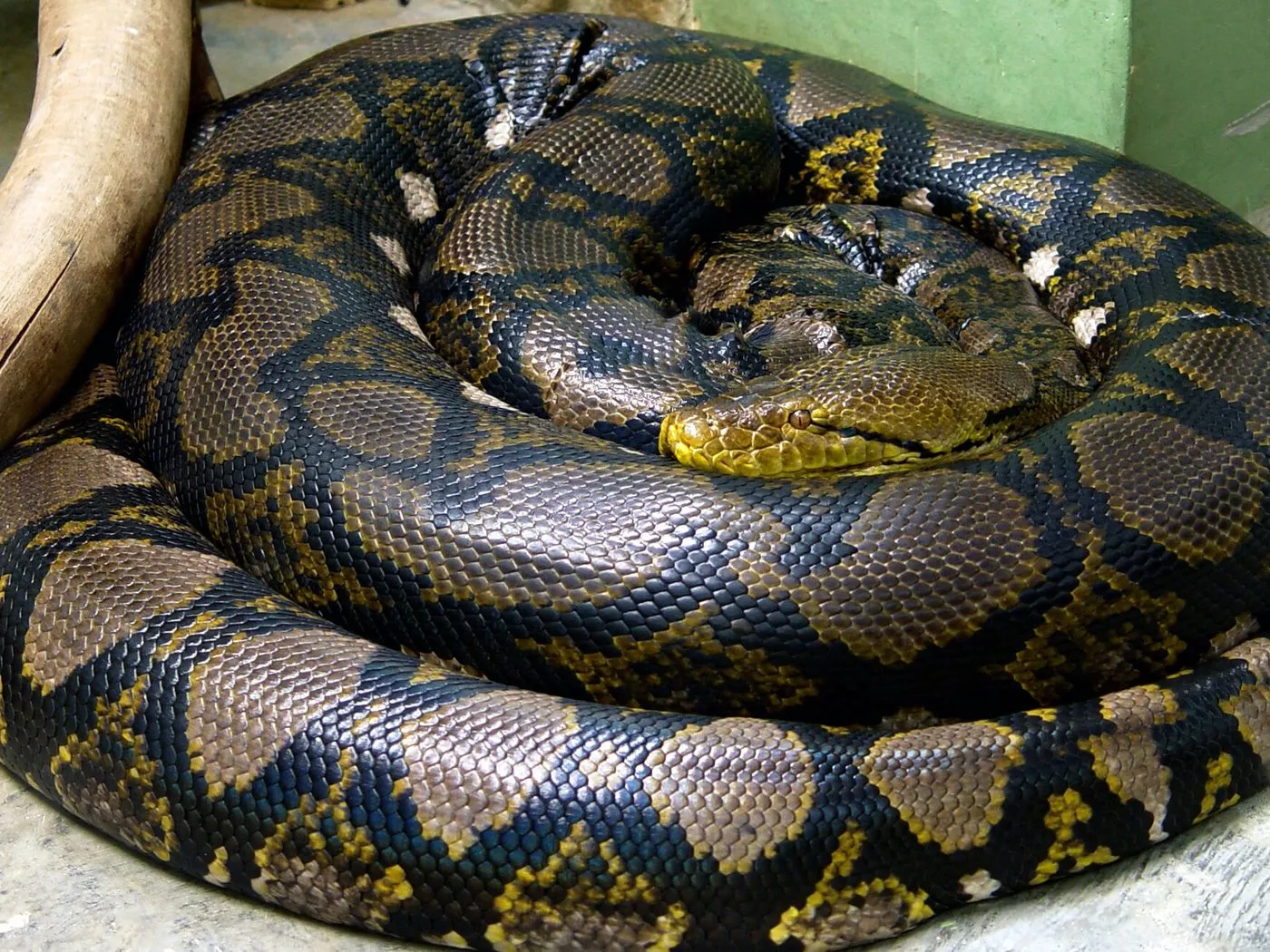
Reticulated python
Malayopython reticulatus
The longest snake in the world. To be kept only in a professionally secured facility, with a permit, proven expertise and an emergency plan.
- Group
- Snake
- Level
- Advanced
- Origin
- Southeast Asia
Where the species comes from
- World region
- Southeast Asia
- Countries
- From Myanmar and Thailand through Malaysia and Indonesia to the Philippines
- Habitat
- Tropical rainforest, riverbanks, plantations and the surroundings of human settlements
The app does not yet hold an origin entry for this species. The distribution given here comes from the specialist literature.
The natural habitat is the yardstick for how you furnish an enclosure. Knowing where an animal comes from is knowing why it needs heat zones, hides and a particular humidity.
Husbandry at a glance
The same details appear in the animal’s profile inside the app.
- Enclosure
- Only in a very large, professionally secured facility; several metres of usable length depending on final size, with robust bathing and climbing areas.
- Temperature
- Basking spot 31–33 °C, cool side 25–27 °C.
- Humidity
- Around 60–80 % with good ventilation.
- Lighting
- Bright daylight; UVB is advisable.
- Substrate
- A robust, moisture-buffering substrate.
- Furnishings
- Solid platforms, hides and a bathing area.
- Water
- A very large, clean water container.
- Feeding
- Thawed prey; feed adults very sparingly and avoid excess weight.
- Behaviour
- Highly intelligent, active and extraordinarily powerful.
- Handling
- Never work with large animals alone; use a target and hook routine.
- Cohabitation
- Keep singly.
- Health
- Weight, airways, mouth, skin and musculoskeletal system.
- Seasonal cycle
- No winter rest: A tropical species without pronounced seasons in its native range. For breeding, a slight drop over six to eight weeks is enough. At this size, any breeding plan is a matter of experience, not of the calendar.
- Safety
- A high-risk giant snake; check local permits and safety requirements.
Legal position in Switzerland
Permit required
Requires a permit. Art. 89 let. f of the Ordinance covers giant snakes growing longer than 3 m as adults; the reticulated python usually grows to 4 to 6 m as an adult. Only the boa constrictor is exempt
Training required
Proof of competence under Art. 85 para. 3 let. c of the Ordinance is required. It is a precondition for the permit and must be obtained before acquisition
Species protection applies
CITES Appendix II: Import and transfer only with papers. When buying, ask for proof of origin and captive breeding
Minimum enclosure dimensions
Annex 2, table 5 of the Animal Welfare Ordinance does not prescribe centimetres but multiples of body length. For this species, item 42 (Large giant snakes): floor area 1 × 0.5 body lengths, height 0.75 body lengths. The floor area applies to at most two animals; each further animal requires an additional 0.2 × 0.2 body lengths.
For this group, body length means the total length, from snout to tail tip. The largest animal in the enclosure is what counts. The enclosure may not be smaller even if fewer animals live in it than the table names.
| Total length | At least |
|---|---|
| 300 cm | 304 × 152 × 220 cm |
| 400 cm | 468 × 234 × 220 cm |
| 500 cm | 653 × 327 × 220 cm |
| 600 cm | 859 × 430 × 220 cm |
For the larger animals the calculation would give a height above 2.2 m. The ordinance allows stopping at 2.2 m but requires a proportionally larger floor area in return, so that the volume is met. The table above already accounts for this.
The ordinance names Python molurus and P. reticulatus. The Burmese python and the reticulated python were only later recognised as separate species and placed under Malayopython respectively.
Animals may temporarily be kept in smaller enclosures: for quarantine, for the treatment of illness and injury, for acclimatisation, for breeding and rearing, and for winter or cold dormancy or aestivation (preliminary remark D on reptiles).
This is the legal lower limit, not a recommendation. An enclosure that meets exactly these dimensions is permitted, but not good for that reason. The details under “Husbandry at a glance” describe how the enclosure should be furnished, not how small it may be.
What the enclosure must provide
Settle the permit and training before acquiring the animal. The enclosure must be solidly built and escape-proof. Depending on the species you must provide a sufficiently large heated water basin, raised resting areas, species-appropriate temperature and humidity values and a winter, cold or dry rest period. For dangerous wild animals the canton may require a safety plan, liability insurance and further conditions.
Paperwork
Keep the keeping permit, certificate of competence, proof of origin, purchase contract and, where applicable, CITES papers. Animals subject to a permit may only be passed on to people who hold the corresponding permit.
These details are a guide, not legal advice. Binding information comes from the cantonal veterinary office; the text of the ordinance is what counts. More on the legal position

