
SpeciesCommon musk turtle
Common musk turtle
Sternotherus odoratus
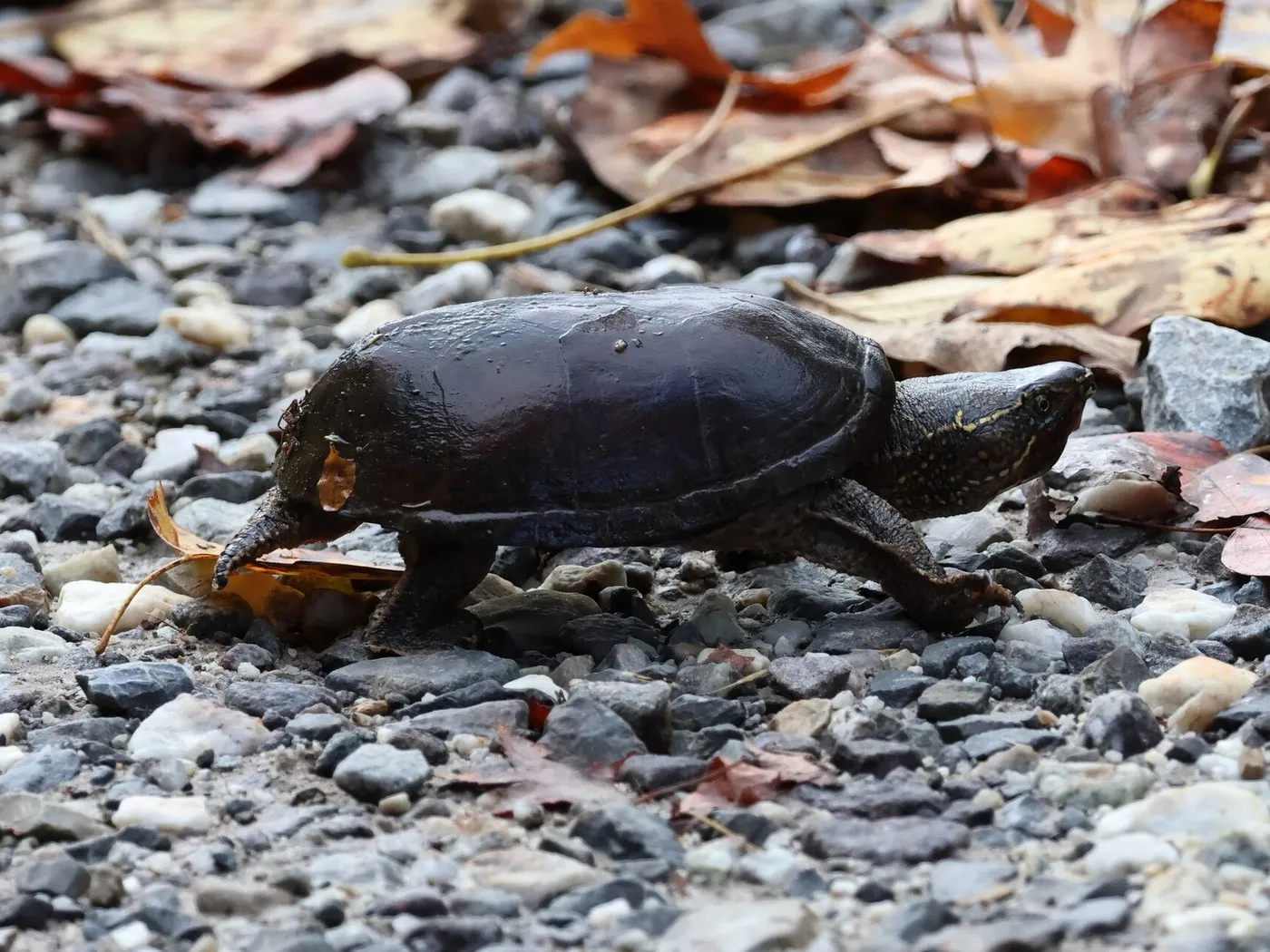
A water turtle that stays small: 12 cm instead of 30. It is the only one of the common species that genuinely lives well in an aquarium rather than merely existing there.
- Group
- Tortoise or turtle
- Level
- Beginner
- Origin
- North America
Where the species comes from
- World region
- North America
- Countries
- Eastern United States and south-eastern Canada
- Habitat
- Shallow, slow-flowing waters with a soft bottom
The app does not yet hold an origin entry for this species. The distribution given here comes from the specialist literature.
The natural habitat is the yardstick for how you furnish an enclosure. Knowing where an animal comes from is knowing why it needs heat zones, hides and a particular humidity.
Husbandry at a glance
The same details appear in the animal’s profile inside the app.
- Enclosure
- An aquarium with 20–30 cm of water and a dry resting spot.
- Temperature
- Water 22–26 °C, basking spot above the water 32 °C.
- Humidity
- Aquatic.
- Lighting
- UV-B above the land section, twelve hours.
- Substrate
- Fine sand or bare bottom; it likes to root about.
- Furnishings
- Plenty of underwater structure to climb, a shallow exit. It swims poorly and prefers to walk on the bottom.
- Water
- A powerful filter and weekly partial change. Water quality decides health.
- Feeding
- Snails, insects, fish, little prepared food. Two to three times a week.
- Behaviour
- Crepuscular, walks along the bottom, basks less often than other water turtles.
- Handling
- Only for checks. When pressed it releases a strong-smelling secretion: Hence the name.
- Cohabitation
- Alone. Several animals need a considerably larger tank and several exits.
- Health
- Shell problems with poor water quality and no dry area.
- Seasonal cycle
- A cooler phase is possible in winter at 12–15 °C.
- Safety
- No permit required. Never release into open waters.
Legal position in Switzerland
No permit foreseen
No permit required. The species does not belong to any of the groups listed in Art. 89 of the Swiss Animal Welfare Ordinance
No certificate of competence foreseen
No proof of competence required. It is only demanded for the animals named in Art. 89 of the Ordinance
Species protection applies
CITES Appendix II: The entire genus Sternotherus is listed. Ask for proof of origin when buying and keep it
Minimum enclosure dimensions
Annex 2, table 5 of the Animal Welfare Ordinance does not prescribe centimetres but multiples of body length. For this species, item 8 (Mud and musk turtles): land section 2 × 2 body lengths, plus water section 4 × 3 at 1 body length depth. The floor area applies to at most two animals; each further animal requires an additional 1 × 1 body lengths of land section and 2 × 2 body lengths of water section.
For this group, body length means the carapace length, measured in a straight line from the front to the rear edge of the shell, not over the curve. The largest animal in the enclosure is what counts. The enclosure may not be smaller even if fewer animals live in it than the table names.
| Carapace length | At least |
|---|---|
| 8 cm | Land section 16 × 16 cm, plus water section 32 × 24 cm, 8 cm at the deepest point |
| 10 cm | Land section 20 × 20 cm, plus water section 40 × 30 cm, 10 cm at the deepest point |
| 12 cm | Land section 24 × 24 cm, plus water section 48 × 36 cm, 12 cm at the deepest point |
| 14 cm | Land section 28 × 28 cm, plus water section 56 × 42 cm, 14 cm at the deepest point |
Animals may temporarily be kept in smaller enclosures: for quarantine, for the treatment of illness and injury, for acclimatisation, for breeding and rearing, and for winter or cold dormancy or aestivation (preliminary remark D on reptiles).
This is the legal lower limit, not a recommendation. An enclosure that meets exactly these dimensions is permitted, but not good for that reason. The details under “Husbandry at a glance” describe how the enclosure should be furnished, not how small it may be.
What the enclosure must provide
A land section with heat and UV-B, clean filtered water, retreat and an exit without a fall risk. Releasing into the wild is forbidden and displaces native species.
Paperwork
Keep the purchase contract and proof of origin. Use the scientific name to check CITES and import status reliably.
These details are a guide, not legal advice. Binding information comes from the cantonal veterinary office; the text of the ordinance is what counts. More on the legal position

