
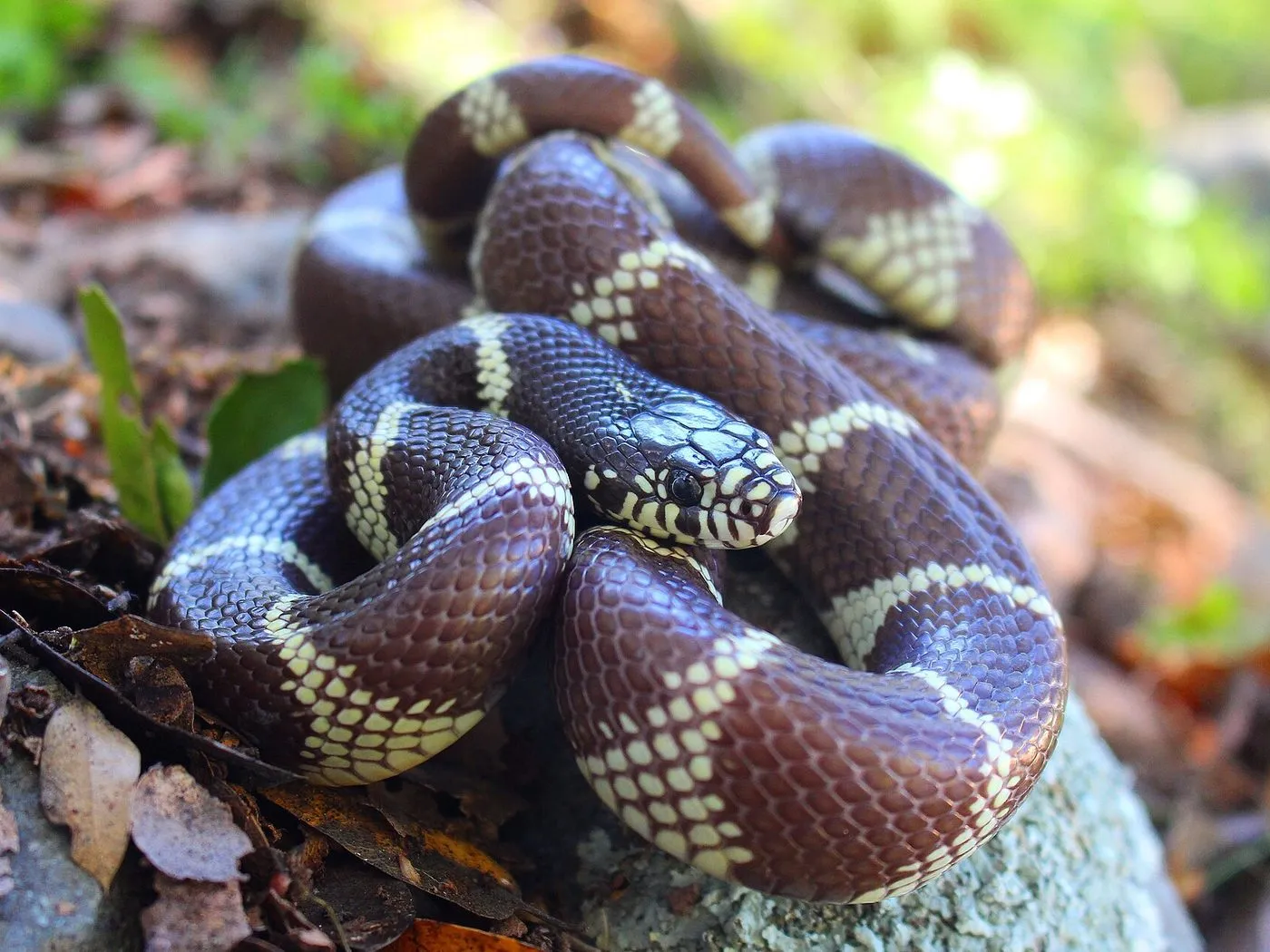
SpeciesCalifornia kingsnake
California kingsnake
Lampropeltis californiae
Alert, active and with a strong feeding response. It will eat other snakes if given the chance. Housing it alone is not a recommendation but a requirement.
- Group
- Snake
- Level
- Beginner
- Origin
- Western North America
Where the species comes from
- World region
- Western North America
- Countries
- Western United States and northwestern Mexico
- Habitat
- Deserts, grassland, forest, coastal regions and rocky terrain
The natural habitat is the yardstick for how you furnish an enclosure. Knowing where an animal comes from is knowing why it needs heat zones, hides and a particular humidity.
Husbandry at a glance
The same details appear in the animal’s profile inside the app.
- Enclosure
- A very escape-proof enclosure with a large floor area. The Animal Welfare Ordinance sets no minimum size for kingsnakes. The reference is the German 1997 expert report on reptile keeping: at least 1 × 0.5 × 0.5 body lengths, i.e. 120 × 60 × 60 cm for a total length of 120 cm.
- Temperature
- Basking spot 28–31 °C, cool zone 21–24 °C.
- Humidity
- Around 40–55 %, with a humid shedding box in one spot.
- Lighting
- Daylight and low-level UVB are advisable.
- Substrate
- A diggable soil and bark mix.
- Furnishings
- Two snug hides, branches, cork and cover.
- Water
- A stable drinking bowl.
- Feeding
- Thawed rodents, guided by body condition.
- Behaviour
- Active, inquisitive and with a strong feeding response.
- Handling
- Wash the scent of food from your hands before and after handling.
- Cohabitation
- Strictly housed alone; it will eat other snakes.
- Health
- Watch the airways, mouth, mites and weight.
- Seasonal cycle
- Two to three months of winter rest at 12–15 °C match the yearly rhythm in the native range. Stop feeding two to three weeks beforehand, then cool down over two weeks and warm up again just as slowly. The rest is a prerequisite for breeding, but not essential for a pet that is not meant to breed.
- Safety
- Excellent escape protection; risk of cannibalism.
Legal position in Switzerland
No permit foreseen
No permit required. The genus is on the list of harmless venomous snakes in the federal veterinary office’s ordinance on keeping wild animals (SR 455.110.3) and is therefore exempt from the permit requirement under Art. 89 let. h of the Ordinance
No certificate of competence foreseen
No proof of competence required. It is only demanded for the animals named in Art. 89 of the Ordinance
No CITES listing
Not listed in the CITES appendices: Import and transfer require no species-protection papers. Keep the proof of purchase nonetheless
Minimum enclosure dimensions
Annex 2, table 5 of the Animal Welfare Ordinance does not list this species. Among snakes the table names only giant snakes (pythons and boas), elapids, vipers and pit vipers, and a few venomous or dangerous colubrids; for the rest no figure appears there.
The general rule in Annex 2 (letter K) then applies: the enclosure must be large enough for everything the species needs (hides, basking spot, climbing branches) to be arranged sensibly. As a yardstick, the ordinance points to expert opinions on a scientific basis. There is therefore no binding figure. The guide values in the calculator come from the 1997 expert report. Binding information comes from the cantonal veterinary office.
What the enclosure must provide
Provide an escape-proof enclosure, species-appropriate temperature zones, suitable humidity, places to retreat, water, substrate and, where applicable, a winter or dry rest period. Feeding live prey is permitted only under the narrow conditions of Art. 4 para. 3 TSchV.
Paperwork
Keep the purchase contract and proof of origin. Import and export are additionally subject to animal health and species protection legislation.
These details are a guide, not legal advice. Binding information comes from the cantonal veterinary office; the text of the ordinance is what counts. More on the legal position

.JPG)