
SpeciesWestern diamondback rattlesnake
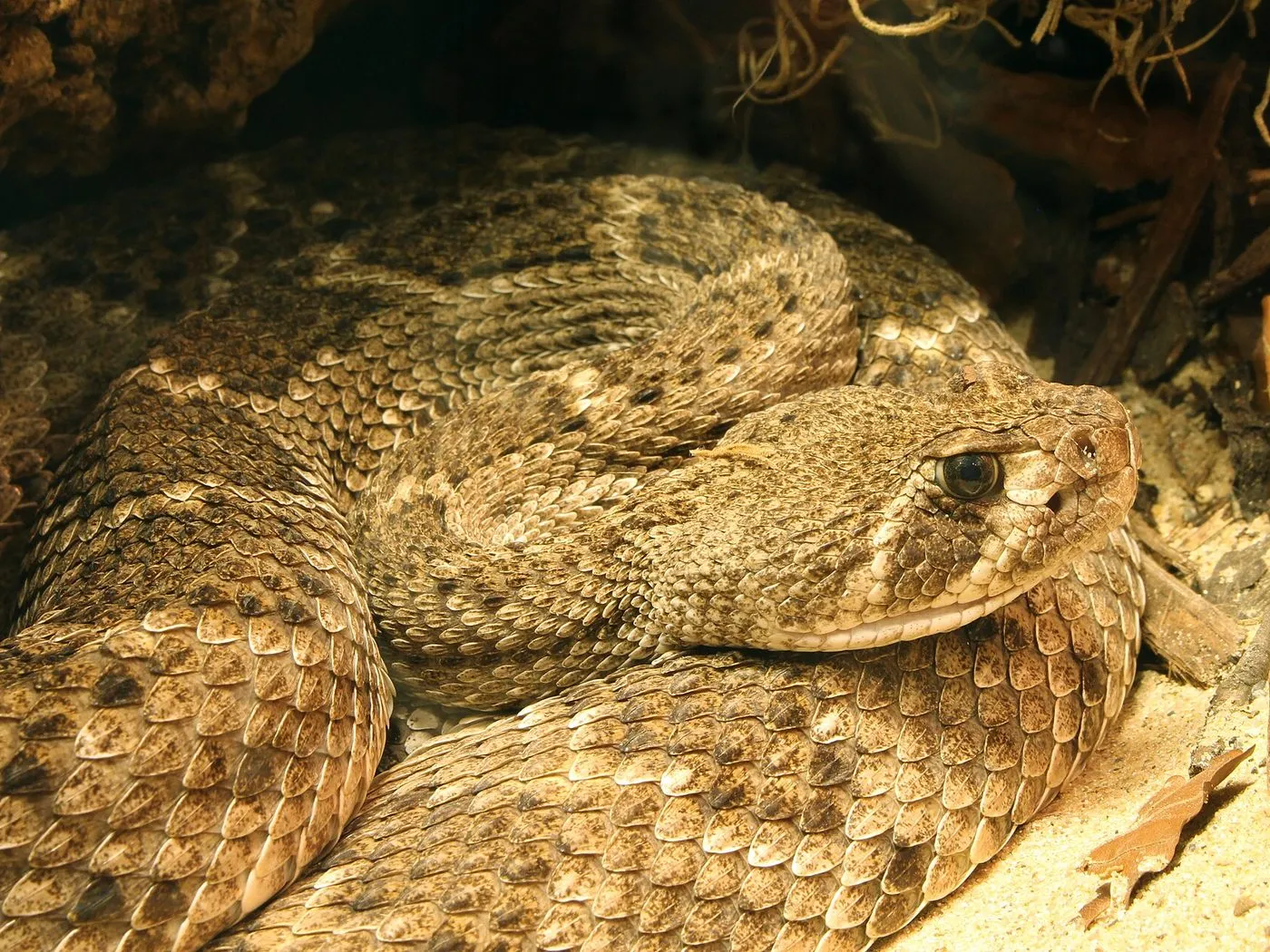
Western diamondback rattlesnake
Crotalus atrox
A species whose venom is life-threatening. To be kept only with a permit, proven expertise, a secured venomous-snake enclosure and a working emergency plan.
- Group
- Snake
- Level
- Advanced
- Origin
- Southwestern United States and northern Mexico
Where the species comes from
- World region
- Southwestern United States and northern Mexico
- Countries
- Texas, New Mexico, Arizona and northern Mexico
- Habitat
- Deserts, semi-deserts, scrubland and dry grassland
The app does not yet hold an origin entry for this species. The distribution given here comes from the specialist literature.
The natural habitat is the yardstick for how you furnish an enclosure. Knowing where an animal comes from is knowing why it needs heat zones, hides and a particular humidity.
Husbandry at a glance
The same details appear in the animal’s profile inside the app.
- Enclosure
- Only in a professionally secured, double-locked venomous-snake enclosure with an airlock and a written working procedure.
- Temperature
- Basking spot around 31–34 °C, cool side 22–26 °C.
- Humidity
- Usually dry, around 30–50 %, with a humid shedding box in one spot.
- Lighting
- A bright day–night cycle and UVB are advisable.
- Substrate
- A diggable, dry soil and sand mix.
- Furnishings
- Secure hides, cover and fixed structures.
- Water
- A stable water bowl.
- Feeding
- Thawed rodents, fed sparingly.
- Behaviour
- Crepuscular to nocturnal, highly reactive and venomous.
- Handling
- No free handling; professional no-contact techniques only.
- Cohabitation
- Strictly housed alone.
- Health
- Carry out checks without contact wherever possible; use a reptile vet experienced with venomous snakes.
- Seasonal cycle
- Two to three months of winter rest at 12–16 °C match the yearly rhythm of the south-western USA. With a venomous snake, every step during cooling and warming is a matter of safety and belongs to husbandry with a permit, training and emergency planning.
- Safety
- Life-threateningly venomous. A permit, proven expertise, an antivenom and emergency plan and local law must all be checked.
Legal position in Switzerland
Permit required
Requires a permit as a venomous snake under Art. 89 let. h of the Ordinance: it covers snakes that have a venom apparatus and can use it. Only species designated harmless by the federal office are exempt; the western diamondback is not among them. Permit and proof of competence are required before acquisition
Training required
Proof of competence under Art. 85 para. 3 let. c of the Ordinance is required. It is a precondition for the permit and must be obtained before acquisition
No CITES listing
Not listed in the CITES appendices: Import and transfer require no species-protection papers. Keep the proof of purchase nonetheless
Minimum enclosure dimensions
Annex 2, table 5 of the Animal Welfare Ordinance does not prescribe centimetres but multiples of body length. For this species, item 55 (Ground-dwelling vipers and pit vipers): floor area 1 × 0.5 body lengths, height 0.5 body lengths. The floor area applies to at most two animals; each further animal requires an additional 0.5 × 0.2 body lengths.
For this group, body length means the total length, from snout to tail tip. The largest animal in the enclosure is what counts. The enclosure may not be smaller even if fewer animals live in it than the table names.
| Total length | At least |
|---|---|
| 90 cm | 90 × 45 × 45 cm |
| 120 cm | 120 × 60 × 60 cm |
| 150 cm | 150 × 75 × 75 cm |
| 180 cm | 180 × 90 × 90 cm |
Sidewinding species are excepted; item 56 applies to them, with 1.5 × 0.5 body lengths.
Animals may temporarily be kept in smaller enclosures: for quarantine, for the treatment of illness and injury, for acclimatisation, for breeding and rearing, and for winter or cold dormancy or aestivation (preliminary remark D on reptiles).
This is the legal lower limit, not a recommendation. An enclosure that meets exactly these dimensions is permitted, but not good for that reason. The details under “Husbandry at a glance” describe how the enclosure should be furnished, not how small it may be.
What the enclosure must provide
Contact the cantonal veterinary office before acquiring the animal. This is mandatory. An escape-proof, lockable enclosure, safe working procedures and, depending on the canton, further safety conditions are required. A permit is granted only if the enclosure, equipment, expertise and protection of people and animals are adequate.
Paperwork
Keep the keeping permit, proof of training, proof of origin, emergency and safety documentation and, where applicable, liability insurance and CITES papers.
These details are a guide, not legal advice. Binding information comes from the cantonal veterinary office; the text of the ordinance is what counts. More on the legal position

_Crotalus_atrox.jpg)