
SpeciesOrnate horned frog
Ornate horned frog
Ceratophrys ornata
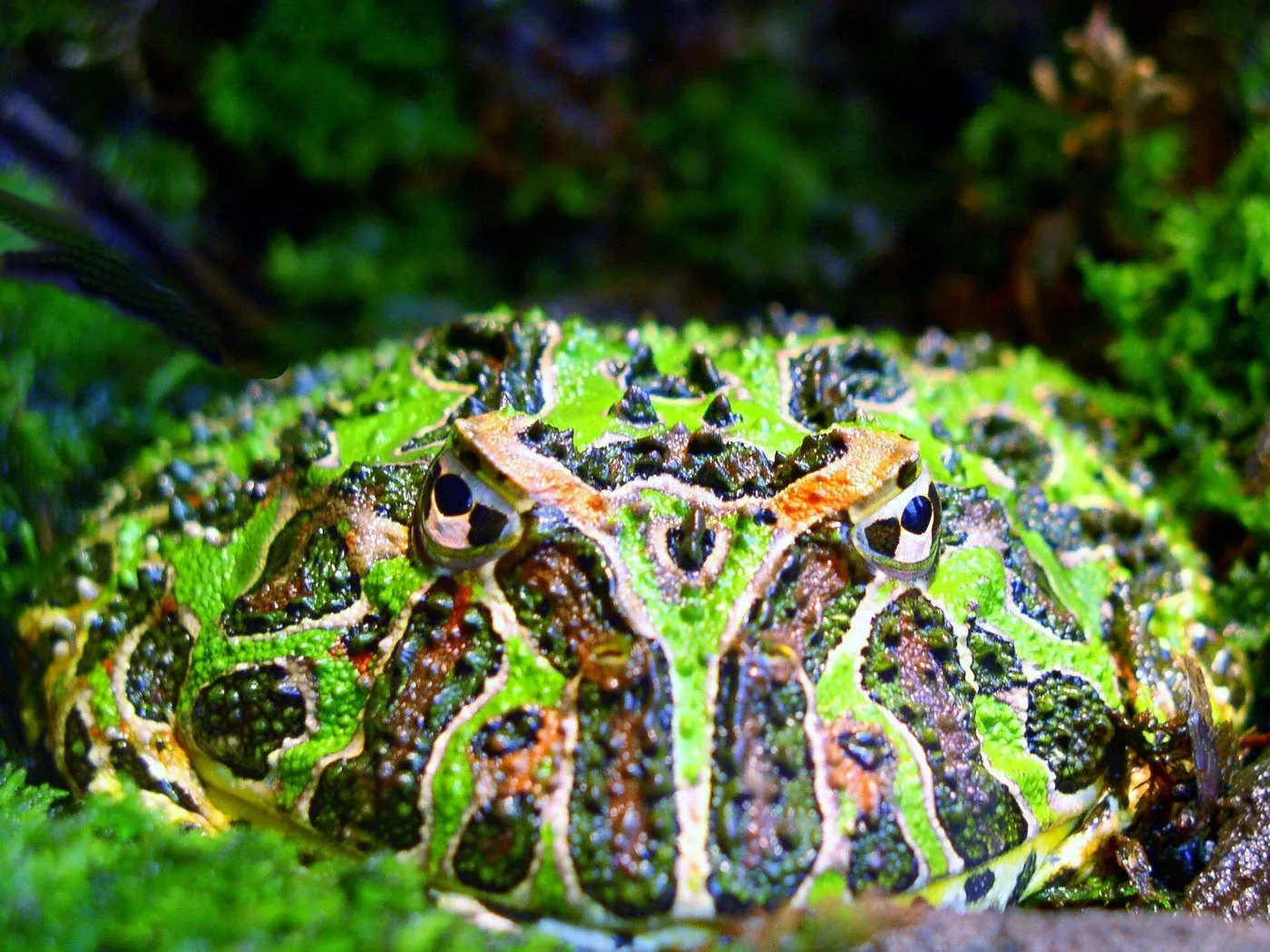
A frog that is almost all mouth and ambushes prey from a buried position. It barely moves: Which makes it easy to keep and equally easy to overfeed.
- Group
- Amphibian
- Level
- Beginner
- Origin
- South America
Where the species comes from
- World region
- South America
- Countries
- Argentina, Uruguay and southern Brazil
- Habitat
- Humid grasslands of the pampas
The app does not yet hold an origin entry for this species. The distribution given here comes from the specialist literature.
The natural habitat is the yardstick for how you furnish an enclosure. Knowing where an animal comes from is knowing why it needs heat zones, hides and a particular humidity.
Husbandry at a glance
The same details appear in the animal’s profile inside the app.
- Enclosure
- For one animal the Animal Welfare Ordinance requires at least 10 × 5 body lengths of floor area and 4 body lengths of height, i.e. 120 × 60 × 48 cm at 12 cm. Large females need more. Floor area before height.
- Temperature
- 24–28 °C by day, 20–22 °C at night.
- Humidity
- 70–80 %, substrate permanently moist.
- Lighting
- Dim light is enough, UV-B is not needed.
- Substrate
- Deep, moist substrate of soil and moss for burrowing.
- Furnishings
- Sparse: moss, a shallow basin, a few plants.
- Water
- A shallow basin the frog fits into comfortably; refreshed daily. Amphibian skin absorbs whatever is in the water.
- Feeding
- Adults every seven to ten days. Insects and occasionally a mouse. More often leads to obesity within months.
- Behaviour
- It sits buried and waits. It snaps hard, at fingers too.
- Handling
- Do not handle. If necessary, with moistened hands or a net: Hand warmth and soap residue damage the skin.
- Cohabitation
- Alone, without exception. Conspecifics are eaten.
- Health
- Obesity and dropsy from feeding too often.
- Seasonal cycle
- No winter rest in the European sense, but a genuine resting phase: In the dry season the ornate horned frog burrows and surrounds itself with a skin cocoon. This is recreated over six to eight weeks with drier substrate at 20–24 °C. No feeding during this time; the animal lives off its reserves.
- Safety
- No permit required. No contact with cleaning agents.
Legal position in Switzerland
No permit foreseen
No permit required. The species does not belong to any of the groups listed in Art. 89 of the Swiss Animal Welfare Ordinance
No certificate of competence foreseen
No proof of competence required. It is only demanded for the animals named in Art. 89 of the Ordinance
No CITES listing
Not listed in the CITES appendices: Import and transfer require no species-protection papers. Keep the proof of purchase nonetheless
Minimum enclosure dimensions
Annex 2, table 6 of the Animal Welfare Ordinance does not prescribe centimetres but multiples of body length. For this species, item 2a (Ground-dwelling frogs from tropical and subtropical climates): floor area 10 × 5 body lengths, height 4 body lengths. The floor area applies to at most two animals; each further animal requires an additional 2 × 2 body lengths.
For this group, body length means the total length of the animal, from snout to the end of the body. The largest animal in the enclosure is what counts. The enclosure may not be smaller even if fewer animals live in it than the table names.
| Total length | At least |
|---|---|
| 8 cm | 80 × 40 × 32 cm |
| 10 cm | 100 × 50 × 40 cm |
| 12 cm | 120 × 60 × 48 cm |
| 14 cm | 140 × 70 × 56 cm |
| 16 cm | 160 × 80 × 64 cm |
For amphibians the height is an average: the enclosure may be higher or lower in places.
Animals may temporarily be kept in smaller enclosures: for quarantine, for the treatment of illness and injury, for acclimatisation, for breeding and rearing, and for winter or cold dormancy (note a to table 6).
For this group the table also requires loose substrate suitable for burrowing on the enclosure floor, so that the animals can retreat into it for aestivation (special requirement 8). Aestivation therefore takes place in the enclosure, not in a smaller container.
This is the legal lower limit, not a recommendation. An enclosure that meets exactly these dimensions is permitted, but not good for that reason. The details under “Husbandry at a glance” work out this minimum for adult animals; they give the minimum, not the ideal.
What the enclosure must provide
Provide species-appropriate heat and light zones, UV-B where needed, suitable substrate, retreats, climbing or digging options, water and natural rest periods.
Paperwork
Keep the purchase contract and proof of origin. Use the scientific name to check CITES and import status reliably.
These details are a guide, not legal advice. Binding information comes from the cantonal veterinary office; the text of the ordinance is what counts. More on the legal position

.jpg)