
SpeciesMexican red-knee tarantula
Mexican red-knee tarantula
Brachypelma smithi
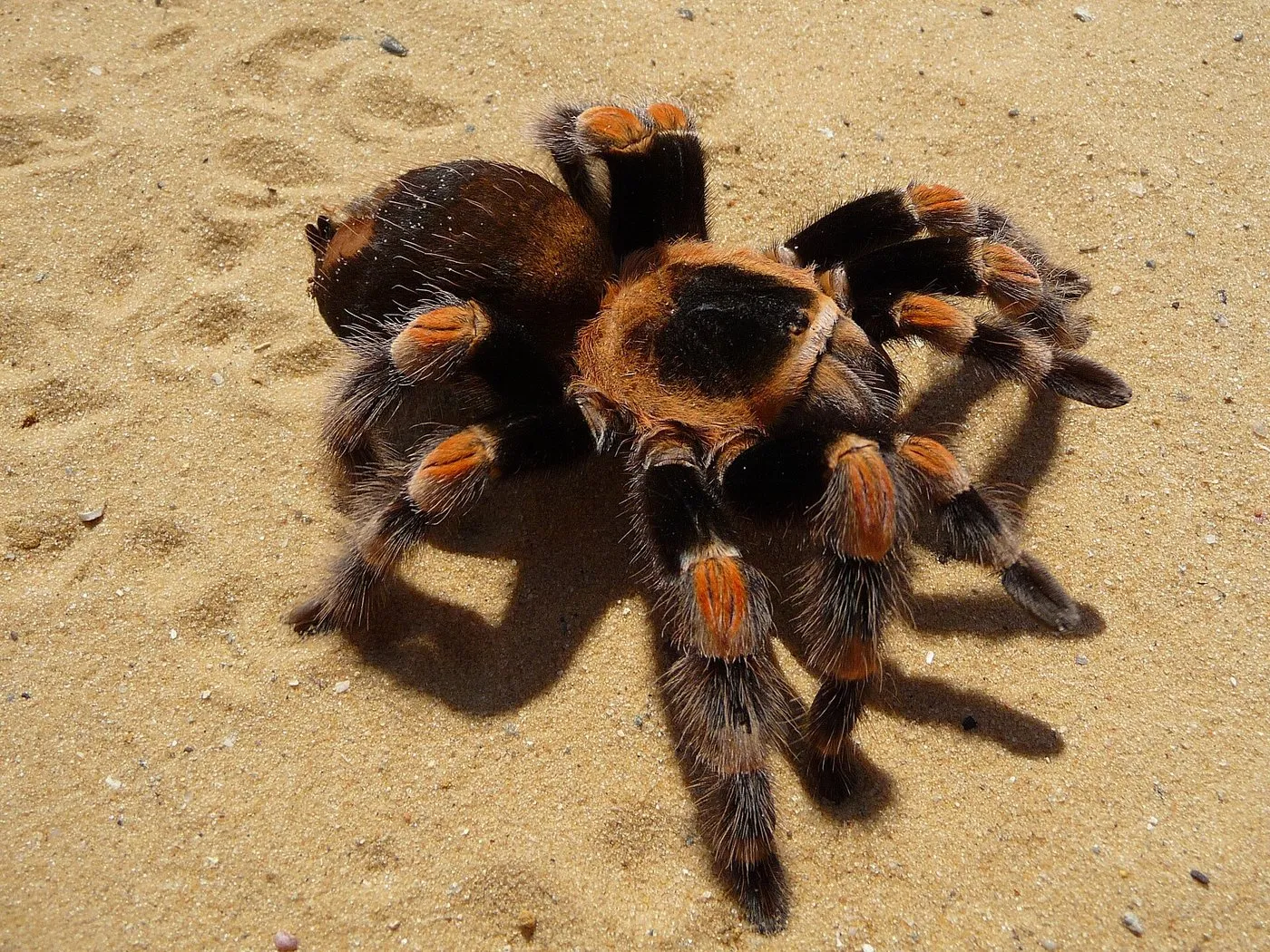
The spider from the films: black with orange-red knees, calm and very long-lived. Females pass twenty years: A long-term commitment. When buying, look at the scientific name: the species was split in 2017, and a large share of animals sold as smithi are in fact Brachypelma hamorii. That changes nothing for husbandry or protection status, but it matters for breeding.
- Group
- Spider
- Level
- Beginner
- Origin
- Central America
Where the species comes from
- World region
- Central America
- Countries
- Pacific coast of Mexico, state of Guerrero
- Habitat
- Dry thorn savannah, self-dug burrows in slopes
The app does not yet hold an origin entry for this species. The distribution given here comes from the specialist literature.
The natural habitat is the yardstick for how you furnish an enclosure. Knowing where an animal comes from is knowing why it needs heat zones, hides and a particular humidity.
Husbandry at a glance
The same details appear in the animal’s profile inside the app.
- Enclosure
- Ground dweller. 30 × 30 × 30 cm for adults, with a digging option.
- Temperature
- 24–28 °C by day, slightly cooler at night.
- Humidity
- 60–70 %. Keep one corner moist, the rest stays dry.
- Lighting
- No lighting needed.
- Substrate
- 10 cm of coco humus or soil mix, deep enough for digging.
- Furnishings
- A cork tube as a cave, flat stones. The spider digs its own burrow.
- Water
- Shallow water dish, always filled.
- Feeding
- Every one to two weeks. More often for juveniles, sparingly for adult females.
- Behaviour
- Placid, but not tame. When disturbed it first tries to flee, then flicks urticating hairs.
- Handling
- Do not pick up: Risk of falling.
- Cohabitation
- Keep singly.
- Health
- Before moulting the spider does not eat for weeks and lies on its back. That is normal, not an emergency.
- Seasonal cycle
- Six to eight weeks of a cooler, drier phase at 20–22 °C match the dry season on Mexico's Pacific coast. Afterwards, back to normal temperature and light moistening of one corner. Longer fasting periods are normal in tarantulas, especially before a moult.
- Safety
- Urticating hairs, no dangerous venom. The species is CITES-protected.
Legal position in Switzerland
No permit foreseen
No permit required. The species does not belong to any of the groups listed in Art. 89 of the Swiss Animal Welfare Ordinance
No certificate of competence foreseen
No proof of competence required. It is only demanded for the animals named in Art. 89 of the Ordinance
Species protection applies
CITES Appendix II: Import and transfer only with papers. When buying, ask for proof of origin and captive breeding
Minimum enclosure dimensions
The Animal Welfare Ordinance does not apply to these animals: under Art. 1 it governs the handling of vertebrates, cephalopods and reptant decapods. There are therefore no minimum dimensions. Housing, climate and places to retreat should still match the needs of the species. The cantonal veterinary office can say whether cantonal rules apply, for example to venomous animals.
What the enclosure must provide
Escape-proof closure, humidity suited to the species, a retreat and water. Spiders are kept singly; most species eat their own kind.
Paperwork
Keep the CITES papers and a receipt bearing the scientific name. For Appendix II they are needed for import and transfer. Cantonal rules may apply to venomous animals; check with the cantonal veterinary office before buying.
These details are a guide, not legal advice. Binding information comes from the cantonal veterinary office; the text of the ordinance is what counts. More on the legal position

