
SpeciesBrazilian rainbow boa
Brazilian rainbow boa
Epicrates cenchria
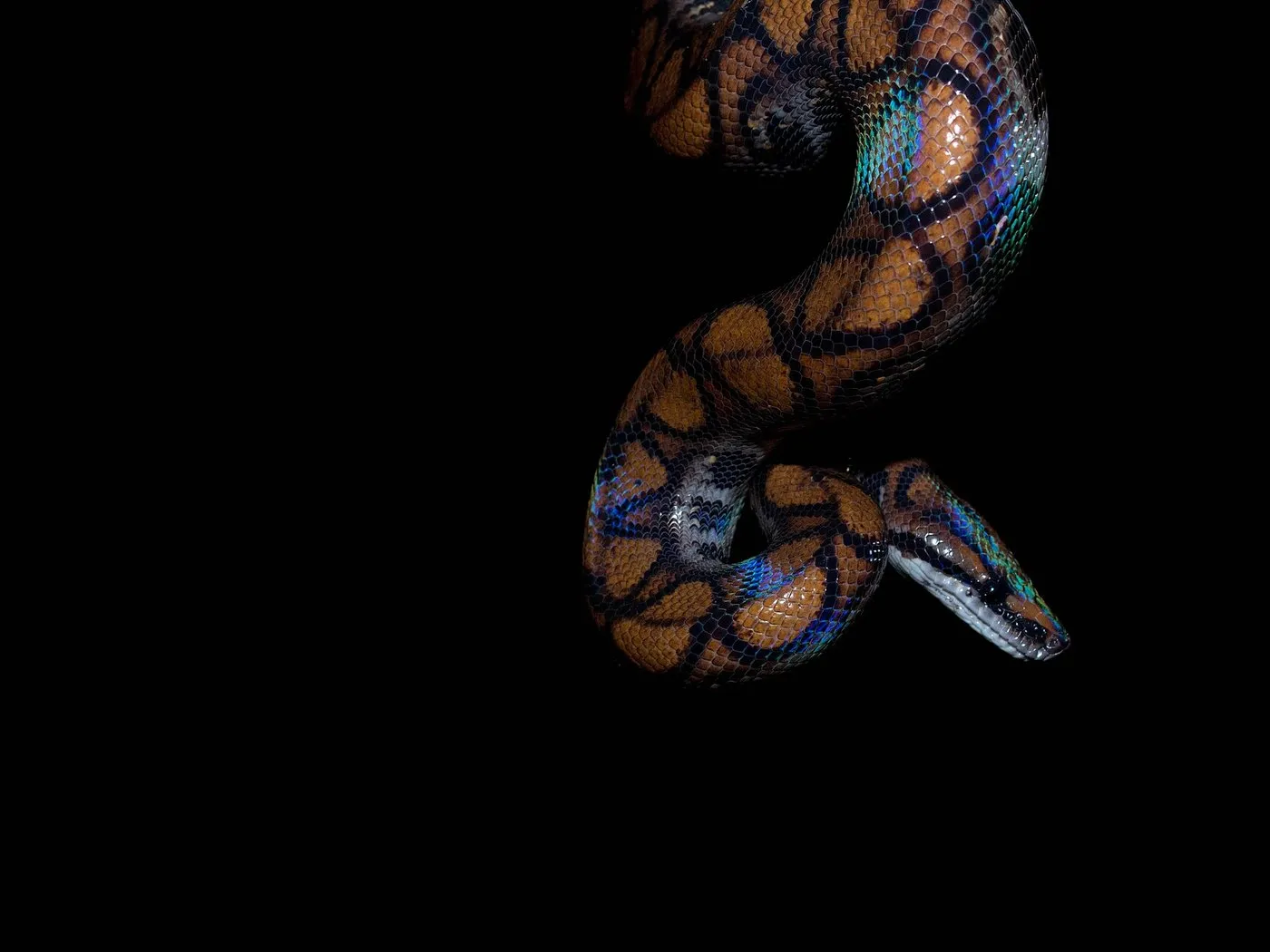
The iridescent sheen on the scales comes from light refraction, not pigment. The species needs considerably more humidity than other boas and answers dryness with shedding problems.
- Group
- Snake
- Level
- Intermediate
- Origin
- South America
Where the species comes from
- World region
- South America
- Countries
- Brazil, Guyana, Suriname and neighbouring countries
- Habitat
- Humid lowland forests and forest edges
The app does not yet hold an origin entry for this species. The distribution given here comes from the specialist literature.
The natural habitat is the yardstick for how you furnish an enclosure. Knowing where an animal comes from is knowing why it needs heat zones, hides and a particular humidity.
Husbandry at a glance
The same details appear in the animal’s profile inside the app.
- Enclosure
- Ground-oriented, with a climbing section and high humidity.
- Temperature
- Warm side 30 °C, cool side 24–26 °C, 22–24 °C at night.
- Humidity
- 75–85 %. Below 70 % the problems start.
- Lighting
- Weak UV-B is beneficial but not essential.
- Substrate
- Deep, moisture-retaining substrate of soil and bark.
- Furnishings
- Sturdy branches, at least two hides, a large water basin.
- Water
- Large bathing basin, refreshed weekly.
- Feeding
- One appropriately sized rodent every ten to fourteen days.
- Behaviour
- Crepuscular and nocturnal, climbs readily. Juveniles bite, adults are usually calm.
- Handling
- Possible, but not for a few days after feeding.
- Cohabitation
- Kept singly.
- Health
- Shedding problems and respiratory infections with the wrong humidity: Too dry as well as too wet.
- Seasonal cycle
- No winter rest: Tropical South America. A drier phase of six to eight weeks with a night-time drop to 22–24 °C matches the yearly rhythm; afterwards, consistently high humidity again. This species is sensitive to being kept too dry.
- Safety
- At around two metres it stays below the three-metre threshold for permit-requiring giant snakes.
Legal position in Switzerland
No permit foreseen
No permit required. The species does not belong to any of the groups listed in Art. 89 of the Swiss Animal Welfare Ordinance
No certificate of competence foreseen
No proof of competence required. It is only demanded for the animals named in Art. 89 of the Ordinance
Species protection applies
CITES Appendix II: Import and transfer only with papers. When buying, ask for proof of origin and captive breeding
Minimum enclosure dimensions
Annex 2, table 5 of the Animal Welfare Ordinance does not prescribe centimetres but multiples of body length. For this species, item 43a (Small and medium pythons and boas): floor area 1 × 0.5 body lengths, height 0.75 body lengths. The floor area applies to at most two animals; each further animal requires an additional 0.5 × 0.2 body lengths.
For this group, body length means the total length, from snout to tail tip. The largest animal in the enclosure is what counts. The enclosure may not be smaller even if fewer animals live in it than the table names.
| Total length | At least |
|---|---|
| 120 cm | 120 × 60 × 90 cm |
| 150 cm | 150 × 75 × 113 cm |
| 180 cm | 180 × 90 × 135 cm |
| 200 cm | 200 × 100 × 150 cm |
Animals may temporarily be kept in smaller enclosures: for quarantine, for the treatment of illness and injury, for acclimatisation, for breeding and rearing, and for winter or cold dormancy or aestivation (preliminary remark D on reptiles).
This is the legal lower limit, not a recommendation. An enclosure that meets exactly these dimensions is permitted, but not good for that reason. The details under “Husbandry at a glance” describe how the enclosure should be furnished, not how small it may be.
What the enclosure must provide
Provide species-appropriate heat and light zones, UV-B where needed, suitable substrate, retreats, climbing or digging options, water and natural rest periods.
Paperwork
Keep the purchase contract and proof of origin. Use the scientific name to check CITES and import status reliably.
These details are a guide, not legal advice. Binding information comes from the cantonal veterinary office; the text of the ordinance is what counts. More on the legal position

_at_night.jpg)