
SpeciesCommon collared lizard
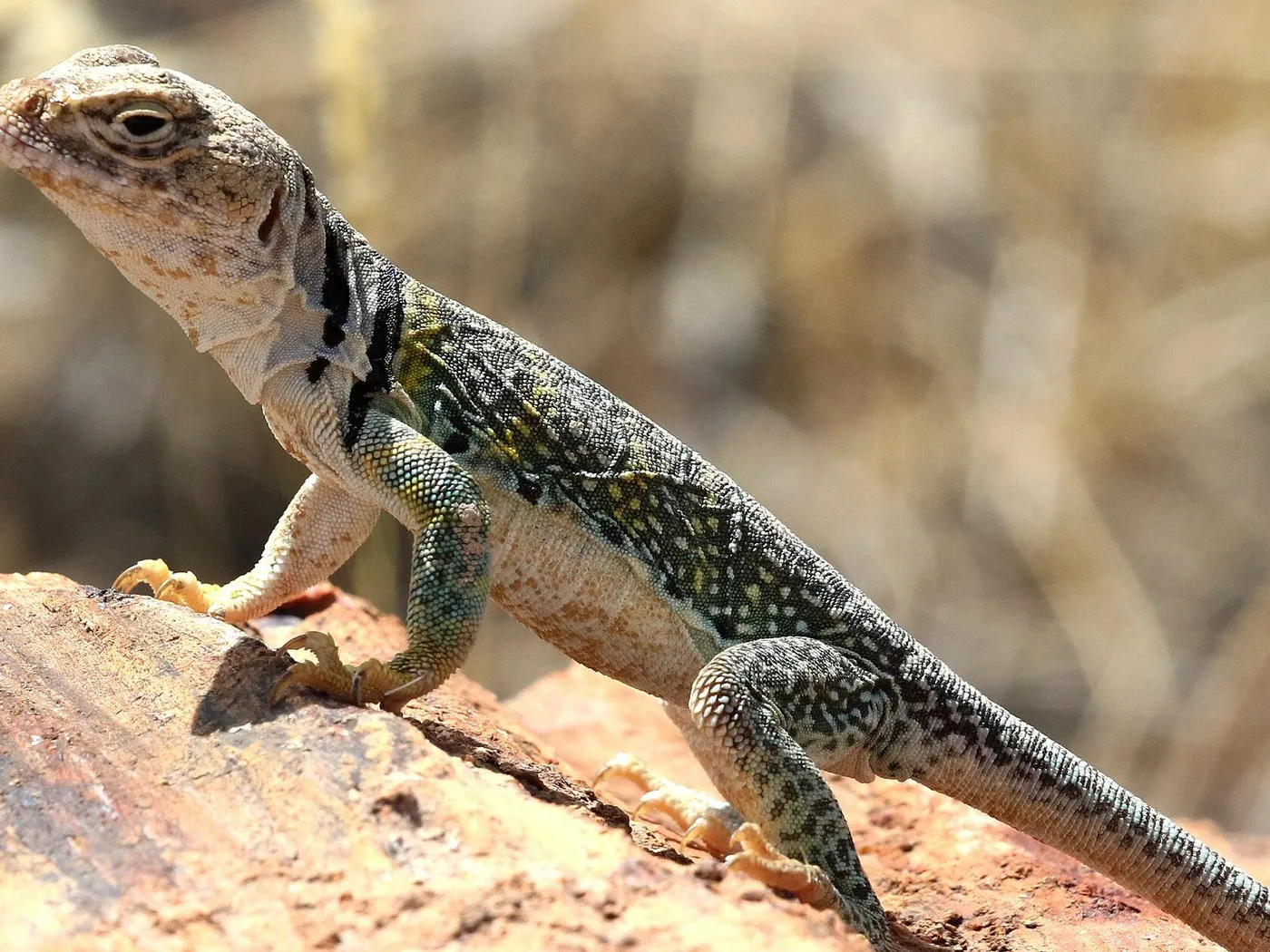
Common collared lizard
Crotaphytus collaris
Brightly coloured, very fast and extremely demanding of heat. When threatened it runs on its hind legs. So it needs distance, and that is where most terrariums fail.
- Group
- Lizard
- Level
- Intermediate
- Origin
- North America
Where the species comes from
- World region
- North America
- Countries
- Central and south-western United States, northern Mexico
- Habitat
- Rocky semi-deserts with open ground
The app does not yet hold an origin entry for this species. The distribution given here comes from the specialist literature.
The natural habitat is the yardstick for how you furnish an enclosure. Knowing where an animal comes from is knowing why it needs heat zones, hides and a particular humidity.
Husbandry at a glance
The same details appear in the animal’s profile inside the app.
- Enclosure
- 150 × 80 × 80 cm for a pair. Running space is not a bonus here but a requirement.
- Temperature
- Spot basking at 45–50 °C, ambient 28–33 °C, 20 °C at night.
- Humidity
- 30–40 %, dry.
- Lighting
- Very strong UV-B, twelve to fourteen hours.
- Substrate
- Sand-loam mix, in places deep enough for digging.
- Furnishings
- Large stone stacks, set stably and not on the substrate: Burrows make loose stones collapse.
- Water
- Shallow dish.
- Feeding
- Sturdy insects, occasionally small rodents for adults. Twice a week.
- Behaviour
- Diurnal, basks at length, flees fast. Males are strongly territorial.
- Handling
- Only for checks. The tail does not break off, but the animal is put under great stress.
- Cohabitation
- One male with one female. Two males are impossible.
- Health
- Keeping too cool leads to digestive problems and loss of appetite.
- Seasonal cycle
- A winter rest of two to three months at 12–15 °C is necessary for breeding.
- Safety
- As an iguanid under one metre in total length it needs no permit: The threshold in Art. 89 of the Ordinance is one metre.
Legal position in Switzerland
No permit foreseen
No permit required. The species does not belong to any of the groups listed in Art. 89 of the Swiss Animal Welfare Ordinance
No certificate of competence foreseen
No proof of competence required. It is only demanded for the animals named in Art. 89 of the Ordinance
No CITES listing
Not listed in the CITES appendices: Import and transfer require no species-protection papers. Keep the proof of purchase nonetheless
Minimum enclosure dimensions
Annex 2, table 5 of the Animal Welfare Ordinance does not list this species. Among snakes the table names only giant snakes (pythons and boas), elapids, vipers and pit vipers, and a few venomous or dangerous colubrids; for the rest no figure appears there.
The general rule in Annex 2 (letter K) then applies: the enclosure must be large enough for everything the species needs (hides, basking spot, climbing branches) to be arranged sensibly. As a yardstick, the ordinance points to expert opinions on a scientific basis. There is therefore no binding figure. The guide values in the calculator come from the 1997 expert report. Binding information comes from the cantonal veterinary office.
What the enclosure must provide
Provide species-appropriate heat and light zones, UV-B where needed, suitable substrate, retreats, climbing or digging options, water and natural rest periods.
Paperwork
Keep the purchase contract and proof of origin. Use the scientific name to check CITES and import status reliably.
These details are a guide, not legal advice. Binding information comes from the cantonal veterinary office; the text of the ordinance is what counts. More on the legal position

