
SpeciesMarginated tortoise
Marginated tortoise
Testudo marginata
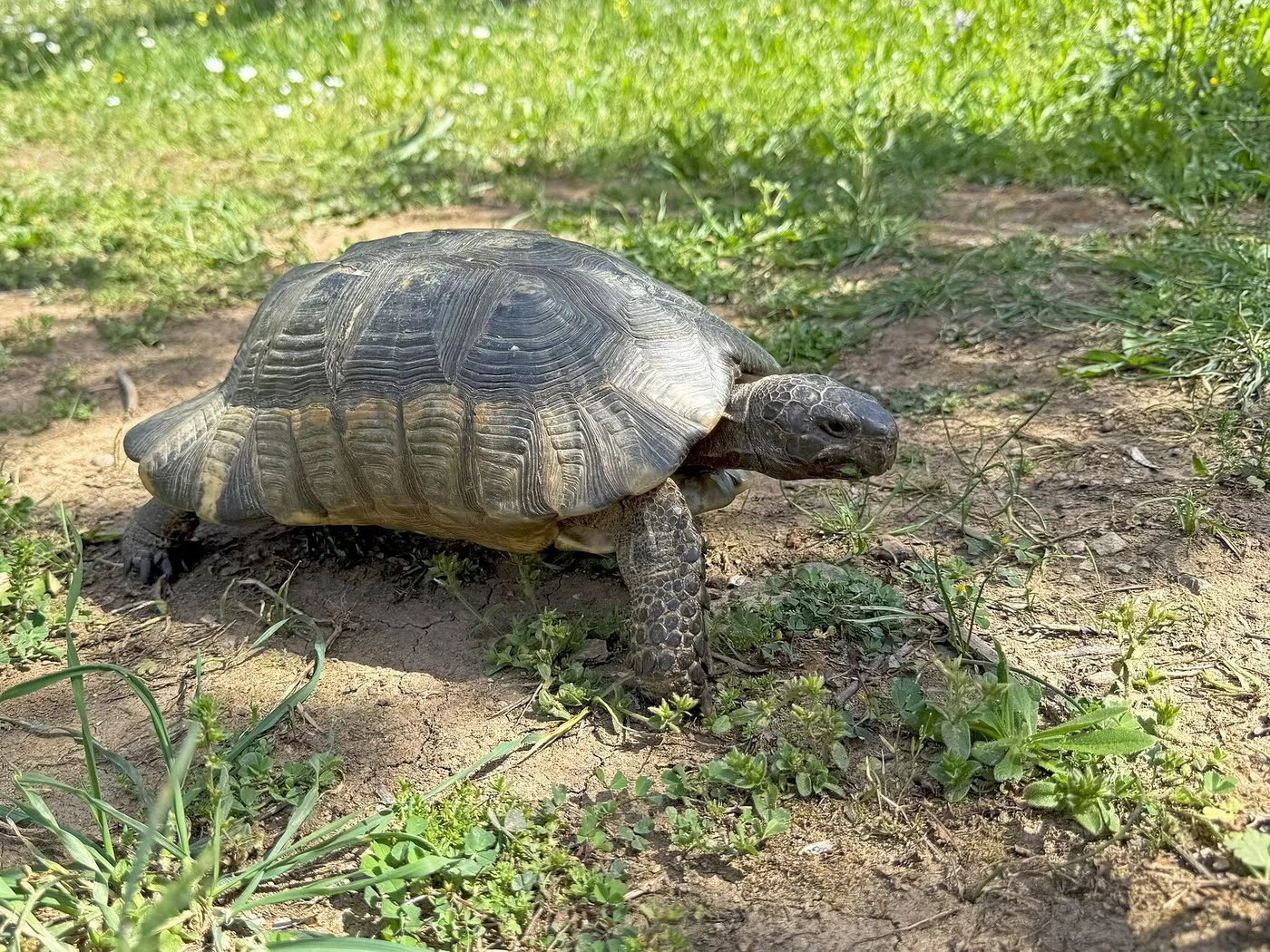
Europe's largest tortoise, with a flared shell rim in old animals. It belongs outdoors for half the year. For this species, indoor keeping is not keeping at all.
- Group
- Tortoise or turtle
- Level
- Intermediate
- Origin
- Southern Europe
Where the species comes from
- World region
- Southern Europe
- Countries
- Greece and Albania; introduced populations on Sardinia and in Tuscany
- Habitat
- Dry slopes with maquis and rocks
The app does not yet hold an origin entry for this species. The distribution given here comes from the specialist literature.
The natural habitat is the yardstick for how you furnish an enclosure. Knowing where an animal comes from is knowing why it needs heat zones, hides and a particular humidity.
Husbandry at a glance
The same details appear in the animal’s profile inside the app.
- Enclosure
- Garden enclosure from 10 m² for one animal, with a cold frame or greenhouse. Indoor keeping only for juveniles and in emergencies.
- Temperature
- Basking spot at 35–40 °C, shaded areas essential. Overwintering at 4–6 °C.
- Humidity
- Outdoor climate; moist retreats and the option to dig.
- Lighting
- Nothing replaces natural sunlight. Indoors, strong UV-B.
- Substrate
- Soil-sand mix with turf, deep enough to bury into.
- Furnishings
- Stone piles, roots, shrubs, an escape-proof border with visual cover.
- Water
- Shallow dish for drinking and bathing, refreshed daily.
- Feeding
- Wild herbs only: Dandelion, plantain, thistle. No fruit, no vegetables, no prepared food. Offer a calcium source.
- Behaviour
- Diurnal, digs, basks at length. Males pester females persistently.
- Handling
- Only for checks. Weighing regularly reveals problems early.
- Cohabitation
- Alone or several females. Two males mean permanent stress. If a male harasses the females constantly — persistent mounting, biting, no way to get away — castration is, from an animal welfare point of view, a better solution than separation in a confined space. The procedure belongs in the hands of a vet experienced with reptiles; it takes away the pressure to breed, not the animal's character. This recommendation comes from Zürcher Tierschutz.
- Health
- A lumpy shell from the wrong food and too little humidity is the most common lasting damage.
- Seasonal cycle
- Hibernation from October to March at 4–6 °C is mandatory, not optional.
- Safety
- No keeping permit required, but proof of origin (Art. 10 BGCITES). Switzerland has no general marking requirement.
Legal position in Switzerland
No permit foreseen
No permit required. The species does not belong to any of the groups listed in Art. 89 of the Swiss Animal Welfare Ordinance
No certificate of competence foreseen
No proof of competence required. It is only demanded for the animals named in Art. 89 of the Ordinance
Species protection applies
CITES Appendix II (Washington Convention). In Switzerland you need papers for every animal that prove its origin and lawful acquisition. They go with the animal when you pass it on (Art. 10 BGCITES). Anyone offering the animal publicly states the CITES appendix, the scientific name and whether it comes from captive breeding or the wild (Art. 7a VCITES). Switzerland has no general marking requirement. The often-cited microchip requirement applies in the EU, which lists the species in Annex A
Minimum enclosure dimensions
Annex 2, table 5 of the Animal Welfare Ordinance does not prescribe centimetres but multiples of body length. For this species, item 4 (European tortoises): floor area 8 × 4 body lengths. The floor area applies to at most two animals; each further animal requires an additional 2 × 2 body lengths.
For this group, body length means the carapace length, measured in a straight line from the front to the rear edge of the shell, not over the curve. The largest animal in the enclosure is what counts. The enclosure may not be smaller even if fewer animals live in it than the table names.
| Carapace length | At least |
|---|---|
| 20 cm | 160 × 80 cm |
| 25 cm | 200 × 100 cm |
| 30 cm | 240 × 120 cm |
| 35 cm | 280 × 140 cm |
Animals may temporarily be kept in smaller enclosures: for quarantine, for the treatment of illness and injury, for acclimatisation, for breeding and rearing, and for winter or cold dormancy or aestivation (preliminary remark D on reptiles).
This is the legal lower limit, not a recommendation. An enclosure that meets exactly these dimensions is permitted, but not good for that reason. The details under “Husbandry at a glance” describe how the enclosure should be furnished, not how small it may be.
What the enclosure must provide
Provide species-appropriate heat and light zones, UV-B where needed, suitable substrate, retreats, climbing or digging options, water and natural rest periods.
Paperwork
Ask the previous keeper for a proof of origin and have it signed; without it the purchase is not legally traceable. Keep the papers for life and pass them on at handover (Art. 10 BGCITES).
These details are a guide, not legal advice. Binding information comes from the cantonal veterinary office; the text of the ordinance is what counts. More on the legal position

